
Math Is Not a Test of Worth

A yellow sharpened pencil laying over a white sheet of paper showing handwritten math equations. Equations include sine a over sine a equals sine b over sine b, y equals h minus 6 t squared over 4, and several sine wave graphs.

When I first began tutoring mathematics and statistics for students in high school and community college, I had expected the hardest aspect to be explaining formulas. What I found was that the real barriers were emotional. Many of the students I worked with were neurodivergent, including those with ADHD or on the autism spectrum. Almost all arrived believing they were bad at math and sharing their fear of it. I know that feeling well. I failed my first college math course at 17 and spent years seeing numbers as a gatekeeper rather than a language I could speak.

Mathematics education often reflects expectations that cut against how many disabled and neurodivergent students learn. Speed is treated as proof of understanding. Timed exams stand in for evaluation. Struggle is framed as deficiency rather than information about the environment or the teaching methodology. These norms did not appear by accident, they are the byproducts of an instructional culture built around uniformity, surveillance, and performance.

I realized in my early twenties that I could not learn mathematics through traditional college instruction. I began using free resources such as Khan Academy and YouTube. Without time limits or pressure, I could think through problems at my own pace. Once I realized that understanding depends on method, not speed, I began to see that the problem was never with my brain or my mind. It was how math is taught. The method and philosophy of teaching mathematics matter as much as the content itself.

Mathematics is often taught as a race toward a correct answer rather than an exploration of reasoning. This approach rewards speed and conformity instead of patience and understanding. That realization shaped how I teach others. My tutoring sessions revolve around three strategies that make mathematical thinking accessible to students who process information differently. The methods I use are scaffolding, metacognition, and reverse solving.

Scaffolding means breaking complex ideas into smaller, connected parts. If a student is learning logistic regression, I start with probability, then move into binary outcomes, and only after that to odds ratios and full models. Each layer builds upon the last. This method prevents students from feeling overwhelmed and helps them experience progress in real time. It replaces the panic of “I can’t do this” with a steadier rhythm of understanding.

Metacognition is the practice of thinking about how we think. I encourage students to slow down and reflect on the process rather than the product. I like to ask questions such as, “What does this result tell you about the problem?” or “How would you explain this to someone with no background in math?” Prompts like these help students examine their own reasoning and reveal what they truly understand. Many begin to notice that what felt like confusion was often just rushed or unexamined thought.

Reverse solving turns the problem around. Instead of starting from the question, we begin with the answer and trace how it could have been reached. This allows students to explore logic without the pressure of uncertainty. It often builds confidence in those who have internalized the idea that they cannot do math. When they can explain how a solution works, they begin to see that the skill was always there.

Taken together, each of these approaches do more than make math easier. They create room for students who have been pushed out of STEM not by inability, but rather by a system that is unwilling to meet them where they are. Many students that I have tutored and taught arrive believing the difficulty signals a personal flaw. However, once they are given time, tools, and permission to think differently, their performance changes, as does their sense of belonging. The broader fight for disability justice includes dismantling norms that confuse conformity with intelligence. Rethinking how we teach math is one piece of that work. It gives disabled and neurodivergent students the opportunity to learn without being told that their brains are the problem.


“Joseph “Joey” Colby Bernert (any/all) is a queer clinical social worker, statistician,  and public health researcher. He works at the intersection of rural health, substance abuse, and epidemiological studies.”

About Rooted In Rights

Rooted in Rights exists to amplify the perspectives of the disability community. Blog posts and storyteller videos that we publish and content we re-share on social media do not necessarily reflect the opinions or values of Rooted in Rights nor indicate an endorsement of a program or service by Rooted in Rights. We respect and aim to reflect the diversity of opinions and experiences of the disability community. Rooted in Rights seeks to highlight discussions, not direct them. Learn more about Rooted In Rights

Tips for Disabled Library Patrons

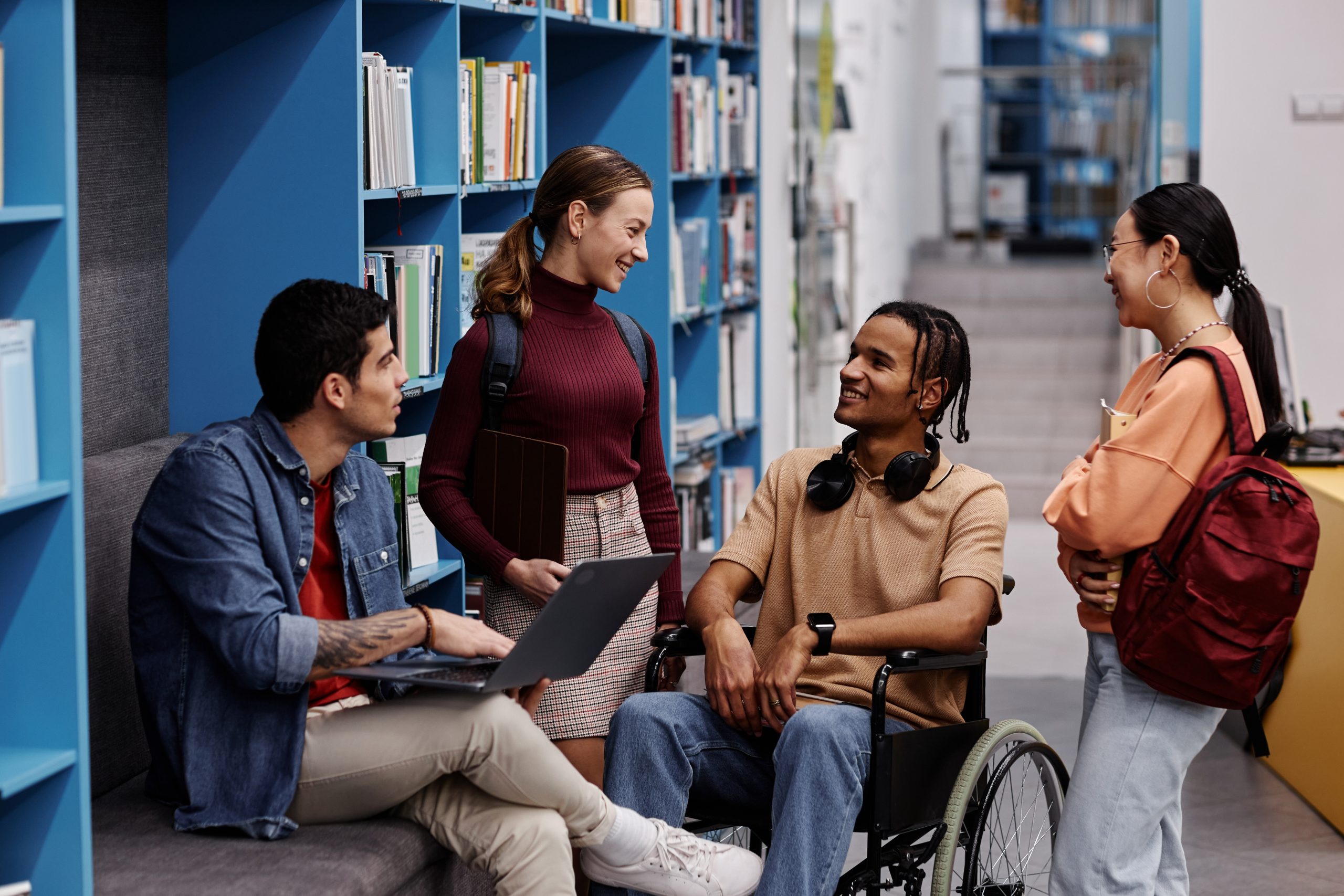
A group of young adult students with various skin colors, phenotypes, and clothing and hairstyles chats cheerfully in a college library, One of the students, a brown-skinned person with short braids, is a wheelchair user.

Public libraries aspire to be places where everyone—including disabled people—belong. They don’t always meet the mark, but disability advocates and disabled people within and outside of library workspaces continue to push for improvements to library spaces, programs, collections, and more. A great example of these efforts is Serving Patrons with Disabilities, a book written and edited by disabled people, published by the American Library Association.

As a disabled library worker myself, I want to provide some tips to fellow disabled library visitors on how to make the most of your local library:

  1. Acquiring Items: Some libraries deliver or mail library items to library visitors unable to leave home due to disability. Eligibility and systems vary, so check with your local library to see what services are available to you! If you can leave your home but would rather not enter the library, you can also ask if your library would be willing to provide curbside pickup services.
  1. Programs: Some libraries already provide programming focused on disabilities or serving disabled library visitors, but if you’re not seeing the kinds of programs you’d like, ask about them! Many libraries are happy to host in-person, hybrid, and virtual meet-ups for support and advocacy groups or to adapt existing programming to be more disability-friendly.
  1. Space: Libraries are not the near-silent spaces they used to be anymore – many have areas where higher volumes are allowed or encouraged. If you have sensory sensitivities, it can’t hurt to bring your favorite ear protection. In addition, public libraries are considered public spaces under the Americans with Disabilities Act (ADA), so if you experience difficulty accessing the physical space of your library, alerting the library of your need can help them to not only better serve you, but to better serve others with similar needs in your community!
  1. Technology: Libraries now offer technology access, predominantly in-library desktop computers. Typically, the software available on these computers is standardized, but libraries are encouraged by our national association to provide screen reading software. Public libraries are also encouraged to offer live captioning, sign language interpretation, adaptive technology, and more. Feel free to suggest your library add any technology which would make your library more accessible to you! If you have a print disability, I encourage you to check out the Washington Talking Book and Braille Library as well, as they have a wealth of resources for print disabled library visitors.
  1. Materials: Many libraries now include a “library of things,” or loanable non-book items, in their collections. Those items tend to include musical instruments, disc drives, or wi-fi hotspots. Although your local library may not already have accessible technology, mobility aids, or similar items available in their library of things yet, you can always encourage them to build their collection in a way which supports disabled community members.
  1. Needing Help: If there’s something you need that you’re not sure your library provides—such as assistance with reaching materials on high or low shelves or with navigating inaccessible websites—feel free to ask! Most libraries have a centrally located desk called a circulation desk, where you check out materials. The staff there are trained to either be able to answer your questions or direct you to a person who knows how to. Library workers aren’t always trained on best practices for helping disabled library visitors and may need some guidance, but staff should be able to help you troubleshoot a solution.

Libraries, like the rest of the world, are in a constant state of change. With the recent dismantling of the Institute for Museum and Library Services, many libraries have lost money which fund services for disabled library visitors, such as talking book and braille libraries and delivery services. If you want your library to continue to support these programs, it’s critical that you make your voice heard, not only to the library, but to your local government and other sources which fund your local library. The items listed here are just a start—there’s a wide variety of ways libraries can (and do!) serve their disabled visitors. So just remember: your ideas for improvements and changes are welcome!


Lex Van Horn (he/they) is a physically disabled and neurodivergent early-career library worker living in rural Washington state. When he’s not working, they play video games, read, write, and play flute.

About Rooted In Rights

Rooted in Rights exists to amplify the perspectives of the disability community. Blog posts and storyteller videos that we publish and content we re-share on social media do not necessarily reflect the opinions or values of Rooted in Rights nor indicate an endorsement of a program or service by Rooted in Rights. We respect and aim to reflect the diversity of opinions and experiences of the disability community. Rooted in Rights seeks to highlight discussions, not direct them. Learn more about Rooted In Rights

Bullseye

A fair- or possibly light-skinned person seen from the neck to the hips. She's wearing a tan or light pink top with a burnt orange cardigan over it and blue jeans with a light brown belt. With shoulder length dark hair, she reaches out her hand for a handshake and friendly 'Hello."

“Yep, I’m partially blind.”

“No, glasses don’t help.”

“Yes, I can get around on my own, in familiar places.”

I do not begrudge for a minute the questions I’m asked anytime I meet someone new and, for example, they see me trying to read. I’ve subconsciously developed a sort of scripted response to the more common questions about my disability.

It goes something like this: “I have bullseye macular dystrophy. It’s a blind spot, shaped in rings, right in the centre of my vision. If I look directly at you, I can’t see you. If I look up, I’m not rolling my eyes; I’m just trying to see your face in case I missed a cue in an expression.”

I hold my fist up in front of my eyes to demonstrate, then I continue. “It’s like macular degeneration, but different. So if I see you and don’t smile or say ‘Hello,’ it’s not because I don’t want to. I just don’t know that it’s you.”

I love talking about my vision: the way I see fascinates me but, more importantly, it’s very useful to me for people around me to understand that I can’t see like them.

I never know who’s around me unless they’re where I normally see them or someone whispers the name of the person approaching. Or, my favourite, when people say “Hi Leslie, it’s [insert name].” I can’t tell you how much of a joyful relief it is when people initiate contact and identify themselves early. Otherwise there’s a very awkward period of trying to guess and not knowing how to act.

It’s hard for me to initiate contact because I’m unable to see faces, so I don’t know if I’m smiling at a person or a bush. For months, I smiled and waved at my neighbour who was always in the same place in his yard, only to later discover that it was actually his garden hose hung on the wall.

It can be lonely. So I cherish the opportunity to “explain about my eyes.” It adds that person to my small, sometimes isolated world—one more person I don’t have to worry about accidentally offending by not saying hello. I can breathe a little easier.

I don’t know if others with a disability feel the same way , but it seems to me that well-intentioned questions are useful and kind, even if they do get a little repetitive. Sadly, there’s no real set of rules to follow when talking to someone about their disability. Even the golden rule doesn’t apply because you can’t know how you would feel in that person’s situation. Everyone is different.

But don’t let the uncertainty deter you. Just like with anyone you talk to, take cues from them, try not to make assumptions about someone’s needs or beliefs, apologize if you cause offence, even if you don’t understand why. 

But most of all, please don’t avoid the conversation just because it might be awkward for a moment. 

As I said once on social media while letting more friends know about my diagnosis: “I look like I can see you, but I can’t see you. If you see me, please say hello. Whoever you are, I miss you.”


Leslie Schmidt (she/her) is an American-born Australian, mother, sculptor and crafter. She has a Bachelor of Visual Art from Monash University. Leslie specialises in making custom, weighted stuffed animals to help with anxiety or sensory sensitivity (or as a baby stats keepsake).

Rooted in Rights exists to amplify the perspectives of the disability community. Blog posts and storyteller videos that we publish and content we re-share on social media do not necessarily reflect the opinions or values of Rooted in Rights nor indicate an endorsement of a program or service by Rooted in Rights. We respect and aim to reflect the diversity of opinions and experiences of the disability community. Rooted in Rights seeks to highlight discussions, not direct them. Learn more about Rooted In Rights
When Disabled Adults Care for Disabled Youth, Everyone Prospers

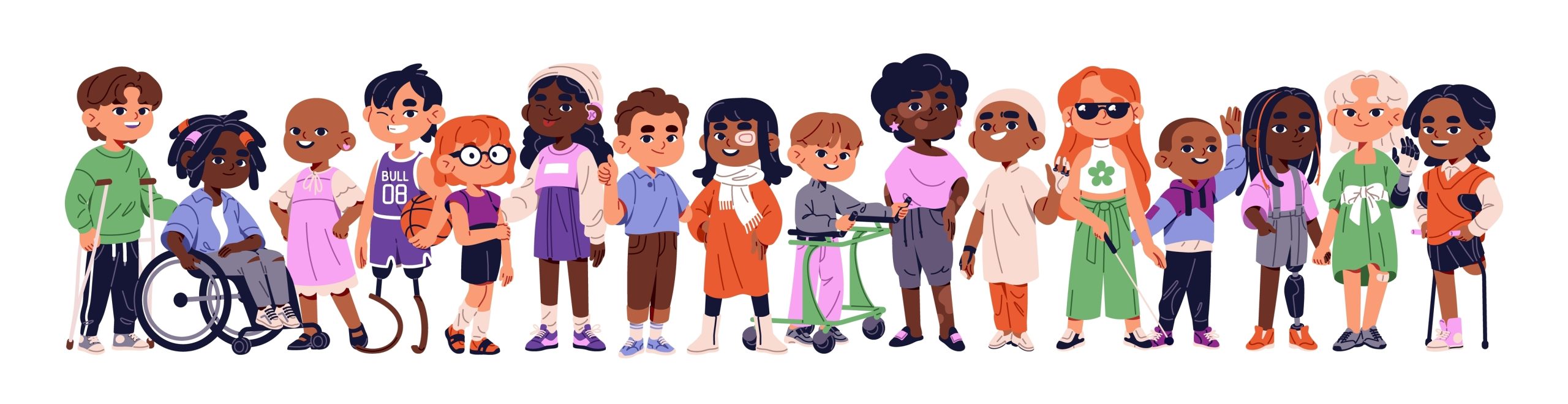
Colorful diverse and inclusive illustration of children. The kids range in disabilities from cancer to amputated limbs and blindness. Mobility aids include a wheelchair and crutches. The kids are various heights and skin colors.

At my community’s youth-facing arts organization, there are no normal days. There are days when poetry prompts turn to discussions of love and worth, days when youth are too exhausted to do anything but curl up in a corner with a Switch, days when they swap hyperfixations instead of paint brushes. And there are days when I, and the other disabled adults running these programs, wake up the morning of a workshop with pain, fatigue, illness, mania, or any other in a long list of symptoms that sends the day’s plan out the window. But we cover for each other. We know what it’s like. And, importantly, we know that people’s well-being is more important than checking off items on a program agenda.

This attitude flies in the face of traditional youth work, where a canceled meeting or a “disengaged” participant is seen as a failure. But it’s better for the youth than a perfect schedule could ever be. They see us caring for each other. They hear us talking about our symptoms, about the challenges of the medical and psychiatric systems. They get advice on caring and advocating for themselves, identifying and addressing ableism, and dealing with symptoms from chronic pain to severe dissociation. When we talk openly about the day-to-day of disabled life, the youth see that there is a future for them – one that doesn’t involve succumbing to the messages they get about their worth, what’s normal, or what they are and aren’t capable of. 

Perhaps more importantly, they get the grace and understanding they don’t from many able-bodied adults. No youth ever has to push themselves to do something they can’t, explain the reasons for a bad day, or mask a part of themselves society tells them to hide. The longer they’re a part of a community where this is normal, the more likely it is that disabled youth will open up about their identity and struggles, share their experiences with us and each other, and ask for what they need. And all youth get a glimpse of what it could look like to live in a world that doesn’t look upon disability as “other.”

It takes work, to be sure. We have to fight to stay in a nonprofit world that can dismiss the consequences of our disabilities as inconsistency or lack of professionalism. We have to show up with N95s to a room full of bare faces. We have to explain that our Discord server isn’t just a fun project for playing games but is an essential piece of building an accessible community.  We have to choose to be open, honest, and caring in ways that don’t always feel easy. And we have to step in to support one another so this work can continue. But all of the extra effort we put into building a new kind of nonprofit culture is well worth the positive impact we have on young people—and each other.


Jaclyn Lewis (they/she) is a writer and youth worker using the power of collaborative storytelling in games like Dungeons & Dragons to create safe and inclusive creative environments for young people. They work with youth at OutFront, Fire Arts, Young Dragonslayers, and the Kalamazoo Public Library and wrote Rolling with the Youth, a guide to running inclusive, safe, and fun tabletop roleplaying games for all ages. She enjoys crafting words, gifts, and community, and can be found on the internet at @wranglerofchaos.

Rooted in Rights exists to amplify the perspectives of the disability community. Blog posts and storyteller videos that we publish and content we re-share on social media do not necessarily reflect the opinions or values of Rooted in Rights nor indicate an endorsement of a program or service by Rooted in Rights. We respect and aim to reflect the diversity of opinions and experiences of the disability community. Rooted in Rights seeks to highlight discussions, not direct them. Learn more about Rooted In Rights
Braille and Leisure in India: 10 Years of White Print Magazine

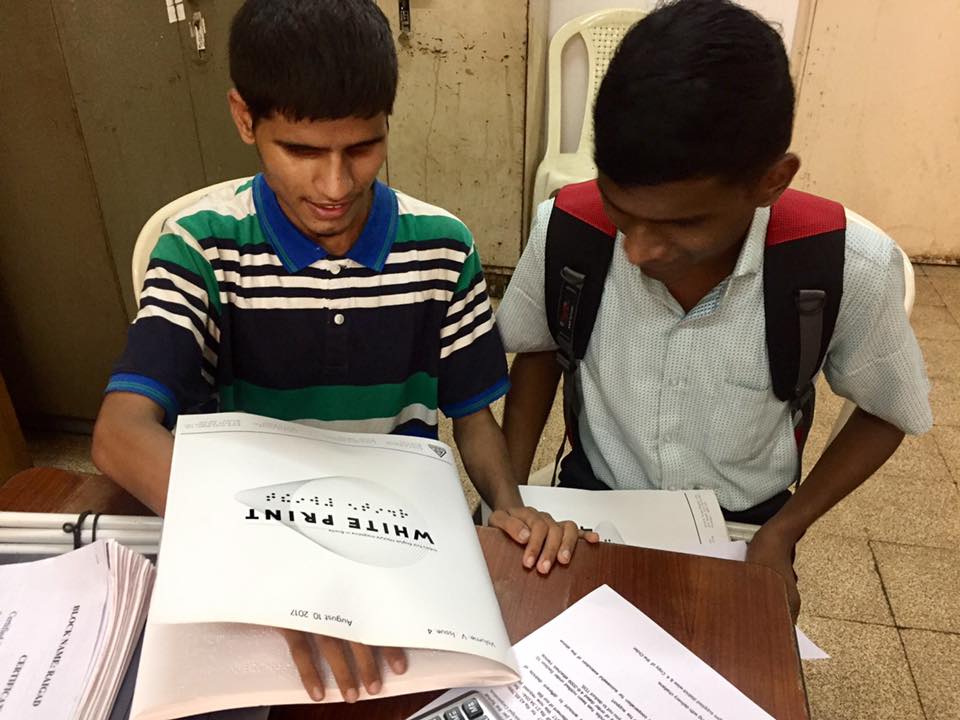
Indoors. Two dark brown-skinned Indian teens, one wearing a bookbag on their back, look down at copies of White Print mag that are located on a brown table.

India is home to more than 18 million blind people; most of us face stigma and discrimination on a day-to-day basis. Apart from inaccessibility and lack of awareness and funds, most blind people find it hard to get a good education or employment opportunities. 

Not many among India’s blind population have the means to buy laptops and smartphones; nor do many of us have access to technology like screen reading software and apps like Audible. While there have been some free audiobooks and textbooks in braille, there hasn’t been anything much in English braille that the blind could read for leisure

Upasana Makati, a former PR professional, loved reading the newspaper every morning. One day in 2012, she suddenly wondered what the blind in India read for leisure. After months of research and conversations with blind people, she realized that there wasn’t any Braille lifestyle magazine in English in India and decided to start one in 2013. The question she pondered was why shouldn’t the blind have access to leisure reading for fun like the sighted do. This was the beginning of White Print magazine, which celebrated 10 years of publishing in May of this year. 

“It feels surreal to have completed a decade. I started at the age of 23 and, during this ten-year-long journey, I have found people who have told me this will not work even for a couple of years. When I spoke to advertisers initially, many people told me it’s not going to work for you.  From that point to completing ten years now without being able to get any sort of massive investment and so, being bootstrapped, it feels phenomenal,” Makati says. 

Due to a lack of funding, she often wrote the content herself and printed the magazine at her own cost at the braille press of the National Association of the Blind, in Mumbai. Printing a Braille magazine is expensive, too. For White Print, the cost of printing has risen from Rs 0.50 ($0.006) per page to Rs 3.00 ($0.036) in the last few years. 

Although White Print had a few innovative brand collaborations in the past, post-pandemic advertising revenue has dwindled. However, Makati is determined to keep publishing the magazine because of the readers, some of whom have been reading White Print since its inception and look forward to it every month.

“Funding is still challenging and printing a Braille magazine is expensive and we’re charging only Rs 360 ($4.34) for twelve issues a year from our individual subscribers. Although some blind people have access to audiobooks, I feel blind people too should have the option to choose between reading a braille copy today and listening to an audiobook tomorrow. Just as sighted people have the option to choose between print, e-books, or audio,” she says.

For a long time, people with disabilities in India have been either seen as sources of inspiration or sympathized with. There is a lack of empathy and understanding. Makati still gets asked why she runs a braille magazine in this age of digital media. She feels this idea comes from a very ableist point of view and would then ask why the sighted still buy books or magazines! 

Dr. Divya Bijur is a physiotherapist from Mumbai; she’s been blind since birth. She has been subscribing to White Print for the last seven years and finds the magazine insightful. Bijur feels White Print has helped her keep her connection with Braille. “I love reading Braille and have studied in Braille since the age of six. White Print covers diverse topics: from music, travel, parenting, nutrition, food, and environment to serious issues facing the world, and I think the work is great because we get to read various reading styles. The quiz is also amazing,” she says.

Although White Print is a lifestyle magazine, Bijur feels it encompasses her life by giving her a peek into the happenings of the world. “Reading generally cheers me up, and I feel ecstatic when I’m reading braille. White Print has been a great companion and at times I feel like throwing off my earphones and just being in peace and reading without sound, and that’s where braille comes to my rescue,” she adds. 

Satish Nikam is a 75-year-old blind retired senior from the state of Maharashtra. He couldn’t study beyond ninth grade owing to trouble in arranging for scribes for his examinations and inaccessibility in general. However, he had always loved reading and learning new things. After working as a telephone operator at a sugar mill for many years, he retired in 2008. 

“I have been reading White Print since it started publishing in 2013. I receive a monthly pension of Rs 900 ($10.81) only and do odd jobs even at this age to sustain myself and my wife. I often couldn’t pay for other materials in braille because printing in braille is expensive. I subscribe to White Print magazine and requested Ms. Makati to let me pay the subscription in installments or consider a concessional rate. Knowing the situation, Ms. Makati hasn’t charged me anything for all these years. The magazine carries articles on a variety of topics and opens up the world for a blind person like me. Although my English is not very great, I have learned a lot from White Print. There are articles on gardening, travel and culture, and so much more. And it gives us, the readers, a different kind of energy and joy,” he says. 

White Print currently has a reader base of 10,000 blind people. Makati feels braille literacy is important for the blind even though many of them are increasingly learning the use of screen readers. “Sighted children are still taught with physical books and taught how to write in cursive or write using pencil and paper,” she adds.

Before the pandemic, Makati had collaborated with several brands to create interesting braille advertisements for the magazine. As advertising is mostly visual and depends a lot on color schemes, design, photography, and infographics, it was something completely new and creative for the brands to think of advertising in Braille. 

“Raymond was the first company that we collaborated with. In October 2013, we had Coca-Cola advertise with us. They inserted an audio ad in the magazine which played a jingle as the magazine was opened. This musical card-like ad was very exciting for the readers as well because they felt a brand had done something specifically for them,” Makati says. 

Sandesh Bhingarde is the founder of a Mumbai-based nonprofit organization called Team Vision Foundation. This voluntary organization works towards empowering visually impaired students in different ways and conducts blindness sensitization workshops. 

“We have been subscribing to White Print magazine for more than a year and a half now. I feel the braille magazine is important because while working with the visually impaired, we’ve found they are missing out on reading and writing. We encourage the students to read in braille because, in many instances, blind students don’t know the spellings of words because they absolutely miss out on reading,” Bhingarde says. 

While there are a few braille magazines in other Indian languages, there was a lack of Braille magazines in English. Students who use screen readers or use text-to-speech and autocorrect are improving their spelling by reading White Print, Bhingarde feels.

As White Print has entered its eleventh year of publication this year, Makati wants to spread the pleasure of leisure reading through braille literacy among a bigger number of blind Indians. 

Just as every sighted child begins their schooling with pen and paper, braille as a script does the same for the blind. If a blind person does not have access to leisure reading via braille literature, their education and growth remain incomplete. Although screen readers like JAWS or NVDA have made it possible for the visually impaired to read, write and access the internet, braille remains the first step towards literacy for the blind. White Print has been trying to bridge the huge gap in the availability and accessibility in braille literature in India for more than ten years; I feel this is an important step towards enriching the lives of the blind in India.


Arundhati Nath (she/her) is a visually impaired independent journalist, content writer, and children’s author from Guwahati, India. Her work has been published in The Guardian, BBC News, Al Jazeera, CSMonitor, and many others. She can be reached at natharundhati@gmail.com and her published work can be viewed on her website.

Rooted in Rights exists to amplify the perspectives of the disability community. Blog posts and storyteller videos that we publish and content we re-share on social media do not necessarily reflect the opinions or values of Rooted in Rights nor indicate an endorsement of a program or service by Rooted in Rights. We respect and aim to reflect the diversity of opinions and experiences of the disability community. Rooted in Rights seeks to highlight discussions, not direct them. Learn more about Rooted In Rights