
Out and Proud at 71: A Retrospective on Queerness and Disability

Illustration of a brown-skinned person's legs and feet. They're wearing white shorts and white sneakers with rainbow patterned socks. They have a white cane.

CONTENT NOTE: ableism

Today, at 71, I’m an out and proud queer, disabled, cisgender woman. I’m also a writer and poet.

I’m open about being legally blind. Tapping my white cane, reading my poetry from text blown up large on my iPad, my low vision is out there for everyone to see. Being low vision is as natural to me as breathing.

Like many of us who came up in a culture steeped in anti-queerness and ableism, I still find myself, from time to time, drowning in moments of shame. I recently found myself apologizing when I saw my eye doctor. “I’m sorry for asking you to dim the lights so I can see the eye chart,” I told the technician.

“You don’t need to apologize,” she said.

Yet, despite these momentary blips of shame, I’m as proud of being a part of the disabled community and disability history as I am of being a part of the queer community and queer history.

But developing pride is far from easy. It takes work. “You get proud by practicing,” the late disabled, queer poet Laura Hershey wrote in her poem of the same name.

I was born disabled. But I didn’t begin to come out and become proud until nearly 50 years ago, in the summer of 1974.

I first learned I was disabled when I was five years old. As long as I said I had some vision (nevermind that it was extremely limited), I could show my face in society. I wouldn’t embarrass my family, scare the neighbors, or frighten strangers.

Being blind was shameful, pathetic—only for beggars hanging out with their tin cups. Except, of course, for the blind musical genius of Ray Charles or Stevie Wonder, who could really sing! Or DeafBlind saint Helen Keller, who’d been “saved” by Annie Sullivan, the miracle worker. (No one ever mentioned that Annie was low vision like me.)

Being a creature of my era I, too, had ableist attitudes towards disability and disabled people for much of my youth. From the time I was a kindergartner—trying to understand why I shouldn’t allow anyone to call me blind—to my early 20s, I was uncomfortable with my own disability and around others with disabilities.

Because I didn’t want to be identified as blind, I didn’t use a cane then, even though I often bumped into walls and sometimes fell down steps. Why did I not get training on how to travel safely—and with self-confidence—with a cane?

But in my junior and senior years of college, I slowly began to feel more comfortable in my skin.

The burgeoning women’s movement (what we now call second wave feminism) began to resonate with me. As a student at a women’s college, I learned that women didn’t have to marry or wear makeup or heels. That we would likely encounter sexism. But we could aim for careers in everything from the arts to medicine and law.

Today I can see what a white, binary version of feminism this was. But it offered liberating possibilities to me and others of my generation, who grew up in a culture of rigid gender and sexual roles. Where a single woman couldn’t get a credit card. A woman who didn’t marry and have kids was considered abnormal (unless she was disabled, of course). And a man would be called “queer” (as a slur) if he cried or liked to cook.

Just a few years after the Stonewall Uprising, I also started to realize (and even enjoy) that I was queer. I’d had feelings that I liked girls since I was 13, but I’d repressed these feelings because “nice” girls weren’t supposed to “like” girls.

But, as I began to hang out with other queer college students, some of whom had marched in Pride parades, I finally began to embrace my sexuality. It would be a while before I had my first same-sex relationship. But I remember watching “The Wizard of Oz” in the late 70s as I held hands with a woman, shortly after I’d come out to myself as queer. I’d never been more happy to see a rainbow!

At this juncture in life, some of my friends and teachers began to nudge me toward at least acknowledging my disability as well, if not outright identifying as disabled. And then I was told about the Perkins School for the Blind in Watertown, a Boston suburb.

I didn’t know what I wanted to do after graduation. But I was ready to live in a city, and I knew I’d need to learn how to safely navigate an urban area. I enrolled in a summer program at Perkins which taught Blind and Low Vision people how to get around safely.

I hadn’t met more than two blind people in my life or crossed a city street alone. I’m not sure which was more terrifying to me: learning to listen to traffic and create an “arc of travel” with my cane or being among a throng of about 50 Blind and Low Vision students and staff.

But I had no idea that this summer would be life-changing.

I began to talk with other Blind and Low Vision people. I discovered that they weren’t “creatures from the Black Lagoon.” Hailing from all over the United States and the world, they were smart, funny and kind. One was a singer who’d performed on talk shows. Another was a baseball fan. Some were cranky. They’d joke about being blind.

We told our stories to each other. I’d often felt that I’d been alone, that I’d been the only one to have been bullied, ridiculed because of my disability. But it turned out that I was far from unique. We’d all been teased, verbally put down, not picked for teams or class offices. Some of us had been beaten up on the playground in elementary school or in the halls of high school.

Gradually, I became aware that there was discrimination against disabled people.

I’d always felt that non-disabled folk didn’t like to be around people like me. But I finally realized that this wasn’t just a “feeling.” Disability-based prejudice was a real thing.

The culmination of my Low Vision coming out process was discovering that people with disabilities have rights. That, though discrimination complaints are quite difficult to win, we can seek legal redress if we encounter disability-based discrimination.

After years of protest, including a historic 1977 sit-in, Section 504 of the 1973 Rehabilitation Act was finally signed in April 1977. Section 504, the precursor to the Americans with Disabilities Act, prohibits hospitals, libraries, schools, courts, and other institutions that receive federal funding from discriminating against disabled people.

Looking back over the half century since that groundbreaking law, how different my life has been from what I expected!

I met, fell in love with and, until her death from cancer, had a long, loving relationship with Anne—the love of my life. Since the early 1990s, I’ve found fulfilling work as a freelance journalist. I’ve written about everything from the role of disabled people in World War II to the hidden history of Helen Keller and an ongoing series for the Washington Blade on people who identify as queer and disabled. I’ve had an essay published in The New York Times, the paper of record. My poem, “Tasting Braille,” has been the Poetry Foundation’s Poem of the Day. I’ve had a wonderful life.


Kathi Wolfe (she/her) is a writer and poet. Wolfe’s commentary and essays have appeared in The New York Times, The Washington Post, The Progressive Media Project, and others. She has been a Rosalynn Carter Mental Health Journalism Fellow, and was awarded a mini-fellowship from the Kaiser Family Foundation and the National Press Foundation to report on assisted suicide and people with disabilities. Wolfe is a longtime contributor to the Washington Blade, the acclaimed LGBTQ+ paper.

Rooted in Rights exists to amplify the perspectives of the disability community. Blog posts and storyteller videos that we publish and content we re-share on social media do not necessarily reflect the opinions or values of Rooted in Rights nor indicate an endorsement of a program or service by Rooted in Rights. We respect and aim to reflect the diversity of opinions and experiences of the disability community. Rooted in Rights seeks to highlight discussions, not direct them. Learn more about Rooted In Rights
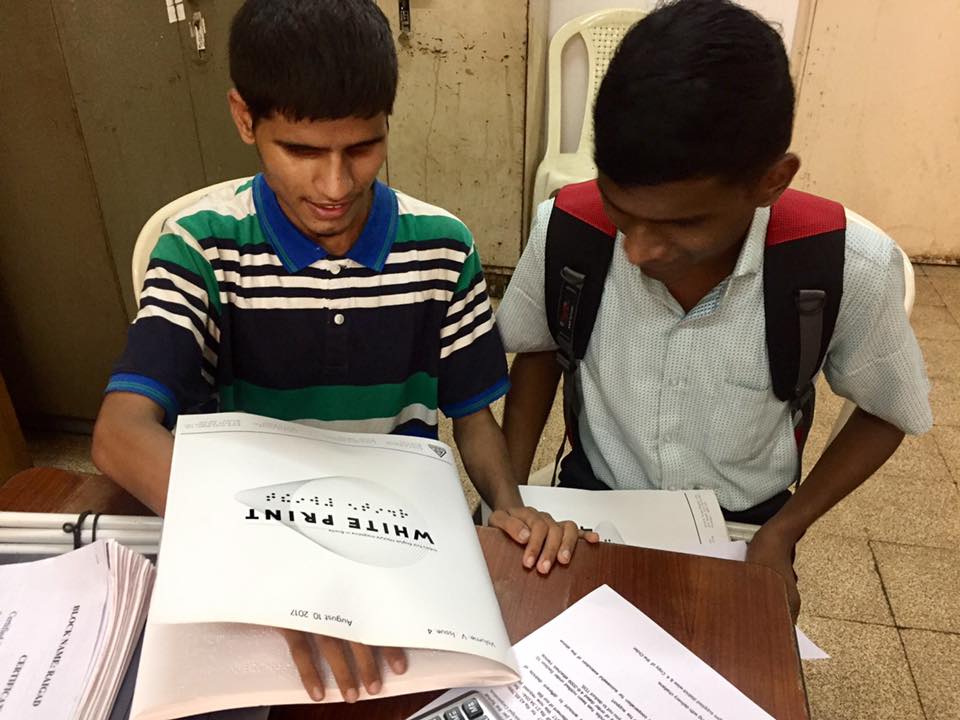
Braille and Leisure in India: 10 Years of White Print Magazine

Indoors. Two dark brown-skinned Indian teens, one wearing a bookbag on their back, look down at copies of White Print mag that are located on a brown table.

India is home to more than 18 million blind people; most of us face stigma and discrimination on a day-to-day basis. Apart from inaccessibility and lack of awareness and funds, most blind people find it hard to get a good education or employment opportunities. 

Not many among India’s blind population have the means to buy laptops and smartphones; nor do many of us have access to technology like screen reading software and apps like Audible. While there have been some free audiobooks and textbooks in braille, there hasn’t been anything much in English braille that the blind could read for leisure

Upasana Makati, a former PR professional, loved reading the newspaper every morning. One day in 2012, she suddenly wondered what the blind in India read for leisure. After months of research and conversations with blind people, she realized that there wasn’t any Braille lifestyle magazine in English in India and decided to start one in 2013. The question she pondered was why shouldn’t the blind have access to leisure reading for fun like the sighted do. This was the beginning of White Print magazine, which celebrated 10 years of publishing in May of this year. 

“It feels surreal to have completed a decade. I started at the age of 23 and, during this ten-year-long journey, I have found people who have told me this will not work even for a couple of years. When I spoke to advertisers initially, many people told me it’s not going to work for you.  From that point to completing ten years now without being able to get any sort of massive investment and so, being bootstrapped, it feels phenomenal,” Makati says. 

Due to a lack of funding, she often wrote the content herself and printed the magazine at her own cost at the braille press of the National Association of the Blind, in Mumbai. Printing a Braille magazine is expensive, too. For White Print, the cost of printing has risen from Rs 0.50 ($0.006) per page to Rs 3.00 ($0.036) in the last few years. 

Although White Print had a few innovative brand collaborations in the past, post-pandemic advertising revenue has dwindled. However, Makati is determined to keep publishing the magazine because of the readers, some of whom have been reading White Print since its inception and look forward to it every month.

“Funding is still challenging and printing a Braille magazine is expensive and we’re charging only Rs 360 ($4.34) for twelve issues a year from our individual subscribers. Although some blind people have access to audiobooks, I feel blind people too should have the option to choose between reading a braille copy today and listening to an audiobook tomorrow. Just as sighted people have the option to choose between print, e-books, or audio,” she says.

For a long time, people with disabilities in India have been either seen as sources of inspiration or sympathized with. There is a lack of empathy and understanding. Makati still gets asked why she runs a braille magazine in this age of digital media. She feels this idea comes from a very ableist point of view and would then ask why the sighted still buy books or magazines! 

Dr. Divya Bijur is a physiotherapist from Mumbai; she’s been blind since birth. She has been subscribing to White Print for the last seven years and finds the magazine insightful. Bijur feels White Print has helped her keep her connection with Braille. “I love reading Braille and have studied in Braille since the age of six. White Print covers diverse topics: from music, travel, parenting, nutrition, food, and environment to serious issues facing the world, and I think the work is great because we get to read various reading styles. The quiz is also amazing,” she says.

Although White Print is a lifestyle magazine, Bijur feels it encompasses her life by giving her a peek into the happenings of the world. “Reading generally cheers me up, and I feel ecstatic when I’m reading braille. White Print has been a great companion and at times I feel like throwing off my earphones and just being in peace and reading without sound, and that’s where braille comes to my rescue,” she adds. 

Satish Nikam is a 75-year-old blind retired senior from the state of Maharashtra. He couldn’t study beyond ninth grade owing to trouble in arranging for scribes for his examinations and inaccessibility in general. However, he had always loved reading and learning new things. After working as a telephone operator at a sugar mill for many years, he retired in 2008. 

“I have been reading White Print since it started publishing in 2013. I receive a monthly pension of Rs 900 ($10.81) only and do odd jobs even at this age to sustain myself and my wife. I often couldn’t pay for other materials in braille because printing in braille is expensive. I subscribe to White Print magazine and requested Ms. Makati to let me pay the subscription in installments or consider a concessional rate. Knowing the situation, Ms. Makati hasn’t charged me anything for all these years. The magazine carries articles on a variety of topics and opens up the world for a blind person like me. Although my English is not very great, I have learned a lot from White Print. There are articles on gardening, travel and culture, and so much more. And it gives us, the readers, a different kind of energy and joy,” he says. 

White Print currently has a reader base of 10,000 blind people. Makati feels braille literacy is important for the blind even though many of them are increasingly learning the use of screen readers. “Sighted children are still taught with physical books and taught how to write in cursive or write using pencil and paper,” she adds.

Before the pandemic, Makati had collaborated with several brands to create interesting braille advertisements for the magazine. As advertising is mostly visual and depends a lot on color schemes, design, photography, and infographics, it was something completely new and creative for the brands to think of advertising in Braille. 

“Raymond was the first company that we collaborated with. In October 2013, we had Coca-Cola advertise with us. They inserted an audio ad in the magazine which played a jingle as the magazine was opened. This musical card-like ad was very exciting for the readers as well because they felt a brand had done something specifically for them,” Makati says. 

Sandesh Bhingarde is the founder of a Mumbai-based nonprofit organization called Team Vision Foundation. This voluntary organization works towards empowering visually impaired students in different ways and conducts blindness sensitization workshops. 

“We have been subscribing to White Print magazine for more than a year and a half now. I feel the braille magazine is important because while working with the visually impaired, we’ve found they are missing out on reading and writing. We encourage the students to read in braille because, in many instances, blind students don’t know the spellings of words because they absolutely miss out on reading,” Bhingarde says. 

While there are a few braille magazines in other Indian languages, there was a lack of Braille magazines in English. Students who use screen readers or use text-to-speech and autocorrect are improving their spelling by reading White Print, Bhingarde feels.

As White Print has entered its eleventh year of publication this year, Makati wants to spread the pleasure of leisure reading through braille literacy among a bigger number of blind Indians. 

Just as every sighted child begins their schooling with pen and paper, braille as a script does the same for the blind. If a blind person does not have access to leisure reading via braille literature, their education and growth remain incomplete. Although screen readers like JAWS or NVDA have made it possible for the visually impaired to read, write and access the internet, braille remains the first step towards literacy for the blind. White Print has been trying to bridge the huge gap in the availability and accessibility in braille literature in India for more than ten years; I feel this is an important step towards enriching the lives of the blind in India.


Arundhati Nath (she/her) is a visually impaired independent journalist, content writer, and children’s author from Guwahati, India. Her work has been published in The Guardian, BBC News, Al Jazeera, CSMonitor, and many others. She can be reached at natharundhati@gmail.com and her published work can be viewed on her website.

Rooted in Rights exists to amplify the perspectives of the disability community. Blog posts and storyteller videos that we publish and content we re-share on social media do not necessarily reflect the opinions or values of Rooted in Rights nor indicate an endorsement of a program or service by Rooted in Rights. We respect and aim to reflect the diversity of opinions and experiences of the disability community. Rooted in Rights seeks to highlight discussions, not direct them. Learn more about Rooted In Rights