Around 2018 I found myself living in an undergraduate household two streets down from my alma mater. I had graduated with no debt, no permanent home for the next year plus, and no real sense of finding work. Frankly, I wasn’t even sure what I wanted to do next with my life. All that I knew was that I had spent a year trying to make my way in the Bay Area and had come home with nothing to show for it. By all accounts, I felt like nothing.
And then something happened that drastically changed the course of my life.
A friend of mine linked me to an application for the Disabled Writers Fellowship program being offered through Rooted in Rights. This year was to be their inaugural onboarding of disabled writers coming from various marginalized backgrounds. She thought I would be a good fit for the program given my previous experience writing monthly blogs covering experiences around Queer, Trans, Black, and People of Color communities. It being a paid position would bring me much needed stability during a time when my accounts were bleeding money. So, I followed her advice and applied for the fellowship.
And I am so glad I did.
Being tasked with a consistent deadline and an editor in noted disability activist Emily Ladau gave me structure I was desperately needing. Having to pump out 2 blogs roughly every 2 weeks meant I had to learn how to concisely write without overdoing it. Being accountable to someone who was patient yet firm in her feedback meant I could grow without suffering to do so. And having money come in meant I could cover rent for once and finally achieve stability, even if it was only for a few months.
Looking back on it, much of what I learned throughout my time as a Disabled Writing Fellow has stuck with me in being an editor for more recent projects. As someone who has edited zine compilations for new tabletop game designers, I was surprised how often Emily’s words came surging back when I helped launch our first zine. Knowing that people often just needed a receptive yet critical voice made giving my own feedback so much easier. Leading with kindness as an editor meant I could give them the same structure the program gave for me, even if people were new to writing. Taking on a role to mentor and support new voices in my community has been one of the greatest joys in my life and I owe much to Rooted in Rights for it.
And so, it is with the greatest sadness that I find myself now looking upon the recent announcement that the blog will be sunsetting at the end of September with bittersweetness. For the past year, I have had the luxury of being a freelance editor for the blog and it has made me think so much more about disability culture and politics overall. In the midst of a growing political context where eugenics has become increasingly legitimized, documenting countervoices has become part of our collective resistance. From covering breaking science on Long COVID research to improving disabled journalism to supporting the latest in disability art and fashion, disabled lives have been making miracles happen. And yet, now we are losing a valuable space for disabled voices to share their truths.
I cannot express my disappointment well enough in writing. Such emotions go too deep for even such a glorious art form to convey their complexity. So, instead, I want to turn to you, the audience, and ask something of you instead. I ask you to remain hopeful and know that Rooted in Rights is but one of many other places still trying to speak to our disabled humanity. RiR is one of many places reminding us that disabled people do not deserve to languish in misery and isolation.
Our communities have always existed and have always found ways to share their beauty, brilliance, and boldness across any number of topics, genres, and mediums. Though unrestricted capitalism and rampant ableism threaten our existence, we will not be made to go quietly. So, please, ensure that our voices do not get smothered out.
Make it so that this world never has enough brown girls like me finding joy in not only learning how to write but also learning to share her knowledge with others. The world could always use more of us.
Rooted in Rights exists to amplify the perspectives of the disability community. Blog posts and storyteller videos that we publish and content we re-share on social media do not necessarily reflect the opinions or values of Rooted in Rights nor indicate an endorsement of a program or service by Rooted in Rights. We respect and aim to reflect the diversity of opinions and experiences of the disability community. Rooted in Rights seeks to highlight discussions, not direct them. Learn more about Rooted In Rights.
When saying goodbye, I guess it’s best to be honest. I’m late getting this to Allexa, in part because I’ve been unsure of what to say. (Also because I was in the emergency room twice in two days with elevated liver enzymes.)
Working at Rooted in Rights has been the longest-running job of any kind that I’ve ever had. That it’s coming to an end – in a precarious job market and economy no less — is unsettling, to say the least. While I haven’t spoken publicly about my specific experiences, my trauma followed me here, marring what should have been a wonderful stepping stone in my career. But it’s also been some of the most rewarding work I’ve ever done, in part because I specifically got to help tell our stories: the diverse, layered stories of disabled people.
So, when contemplating how to bid this chapter of my life farewell, I knew that I wanted to focus on just that — what it means to edit the narratives of disabled, Deaf, Blind, and chronically ill people.
I didn’t want to leave readers with Ars Poetica prose about the craft of editing (mostly because I know that no one wants to read that). But I do think, especially in these times, thinking about what it means specifically to edit the voices of people from oppressed groups matters. (Yes, even as a hypermarginalized person like myself.)
I’ve had the honor of editing everything from essays about voting rights and legislation to parenting while disabled. I’ve helped writers navigate stories about alcoholism and fat antagonism. In all of these collaborative experiences, like any decent editor worth their salt, my focus is on making writers’ work the best it can possibly be.
But as a hypermarginalized person who started their career as a writer first, I’m keenly aware of the power I wield as an editor. There is a responsibility I have to make sure that, when I’m editing, I’m not “correcting, revising, or making changes” to the core of who that writer is, to make their disability (or Blackness or fatness or transness) more palatable to those with more privilege.
What does that mean? Well, it can be a delicate balance. For example, language usage is a common issue among a variety of disabilities. Not just slurs, but what do we call ourselves? How do we describe our experiences? And what if I’m editing someone who’s writing about a disability I don’t have? I also have to take into account that the writer’s perspective, while paramount, is not the only one I must consider. Readers with the writer’s disability will also have valid opinions about how a story is told.
Sometimes I’ve felt like I nailed it, developing a rapport with a writer that allows for the trust necessary to navigate sometimes sensitive issues. Other times I’ve been less sure.
As media, journalism, and entertainment continue to, in my opinion, buckle under the combined weight of fascism and capitalism, my concern continues to be not just the question of whose stories are elevated, but *how* they’re told. Who decides what words, phrases, and imagery make it to the front page…or stay in the drafts? My hope, as I wait for the next chapter in my career to begin, is that the decision-making falls to the next disability publication. My hope — my belief — is that we always find a way to tell our stories…our way.
Denarii Grace (she/they – mix it up!) is a multi-hyphenate writer and editor, singer, and long-time activist. Founder of Fat Acceptance Month, they’ve been an editor with Rooted in Rights since May 2022. She can be found on Facebook, Threads, and Instagram @writersdelite.
About Rooted In Rights
Rooted in Rights exists to amplify the perspectives of the disability community. Blog posts and storyteller videos that we publish and content we re-share on social media do not necessarily reflect the opinions or values of Rooted in Rights nor indicate an endorsement of a program or service by Rooted in Rights. We respect and aim to reflect the diversity of opinions and experiences of the disability community. Rooted in Rights seeks to highlight discussions, not direct them. Learn more about Rooted In Rights
CONTENT NOTE: mentions of suicide, eating disorder, and substance abuse. Reclamation of ableist phrase.
Before I was formally diagnosed with AuDHD, a psychiatrist told me there was no way I could be autistic because I was a regularly-booked comedian. According to this medical professional, autistic people “couldn’t be funny.”
This sentiment confused me for two reasons: 1) did this psychiatrist realize just how not-funny they were? And 2) has this psychiatrist ever met comedians? You’re telling me that monologuing about your observations and interests to a captive audience of people you don’t have to make eye contact with is a neurotypical activity?!
I found stand-up at 18 as I was simultaneously coming into my queerness, transness, neurodivergence, disability, and newfound independence as an adult. Open mics at bars and local clubs became my second home where I met folks of all ages, cultural backgrounds, and life experiences. I not only felt validated but celebrated for my personal brand of “crazy.”
I met other awkward and painfully self-aware outsiders who never quite fit in with our communities. It was the first time I met queer, neurodivergent, disabled adults living the kind of beautifully messy creative life I dreamed about.
I started comedy as a sheltered and deeply suicidal college student in need of community and an outlet. Within a few months I found myself a regularly-booked act and even became an open mic host, interacting with dozens of comedians a day. In my final year of college, I wrote and filmed a one-hour stand-up show, toured that show around the country, and produced several events in my city. I even got the incredible opportunity to open for some big names. And I loved every moment of it.
There’s the adage that “laughter is the best medicine.” But, there’s also the reality that many comedians rely on self-medication to survive in such a grueling industry, whether it’s drugs, alcohol, self-loathing, or denial of burnout. I didn’t know I was dealing with the effects of Long COVID and other chronic illnesses at the time, but I did know that the more I tried to embody the romanticized comedian hustle—hitting up multiple open mics a week, exhausting my social battery in the name of schmoozing, skipping meals and sleep for the sake of “the game,” etc.—the sicker I got.
Unfortunately, I got to a point where I was sick all the time, chronically lost my voice for a year, went through a major eating disorder relapse, and, somewhat thankfully, expedited my diagnoses of fibromyalgia, hypermobility spectrum disorder, and PMOS.
I hate how readily we associate the trope of a comedian with hyper-independence, profound loneliness, and grinding to the point of exhaustion, which starkly contrast principles of disability justice. If comedy is meant to be an act of creating collective joy (out of literally nothing but sounds and vibes), why do we expect comedians to be so miserable, and often glorify it?
Disability representation in comedy is not just about booking more disabled comedians (although that’s very important!), but about dismantling the ableism ingrained in our idea of what it must take to be a comedian. Comedy is an art form that especially attracts us neurospicy, anxious, marginalized folks who finally have a chance to be heard, which makes it all the more disheartening how quickly we accept comedy as a business that decimates our emotional, financial, and physical well-being. It not only makes the creative practice harder to access, but continues to keep the industry centered on cis-het white male perspectives that I’m frankly bored of.
A lot of people think stand-up is an art form about laughter; I personally think stand-up is an art form about truth. In stand-up, we bend reality through meticulous, intentional narratives to elicit responses of joy and amusement from an audience. How might we experiment with truth-telling to evoke the disabled joy we so deeply need, and so deeply deserve? And how might we dream up our own narratives on how to adequately support, sustain, and compensate comedy-making to truly center joy in our liberatory practices?
Nik Narain (he/they) is a queer disabled South Asian American comedian, science communicator, musician, writer, and visual artist based in Durham, NC. You can find his work at niknarain.weebly.com or on Instagram @n1k_creat3s.
About Rooted In Rights
Rooted in Rights exists to amplify the perspectives of the disability community. Blog posts and storyteller videos that we publish and content we re-share on social media do not necessarily reflect the opinions or values of Rooted in Rights nor indicate an endorsement of a program or service by Rooted in Rights. We respect and aim to reflect the diversity of opinions and experiences of the disability community. Rooted in Rights seeks to highlight discussions, not direct them. Learn more about Rooted In Rights.
There is always a bittersweet feeling for me whenever Pride comes around every year.
On the one hand, I’m always grateful to be reminded that I am not in fact the freak various conservative politicians paint me to be. Being around other community members makes me feel oddly normal. I suddenly become just another girl who likes video games, goes on museum dates with my fiance, and likes to write poems. I’m just like everyone else.
On the other hand, even just making the walk over to Pride reminds me that isn’t true. Even as I trek over from a nearby bus stop in the daytime, I worry if someone is going to kill me. I worry if someone is going to stab me repeatedly like they did to Juniper Blessing just a few months ago. I worry if walking back with my partner as visibly trans people we will be shot and left for dead just like Shyell Sanchez-McCray was in Virginia. Or worse yet, maybe people won’t remember us at all. Maybe we will be deadnamed by our surrounding community and people will have to speculate about our deaths like they have with Marlow Trottie in Louisiana.
I don’t say any of this to detract from the much needed joy that has been brought to my life while living in Seattle. Ever since I moved here about seven years ago, I have been fortunate enough to see more trans people than I ever previously did. The first event I attended was even Tran Pride where I first got to see just how expensive trans existence and expression could be. Riding transit in my everyday life, I have not typically worried about people assaulting me or people spewing vitriol at me even though I do expect it to happen. My life is at nowhere near the same level of risk as other places across the US and I am not as likely to die for being trans while residing here.
But being trans and disabled makes things…complicated.
Having wandered around several booths at the most recent Trans Pride, I couldn’t help but notice the plethora of disabled folk among the attendees. So many people used mobility aids like walkers, canes, and even crutches to maneuver around the park. I couldn’t help but smile and compare my own flower cane with others or think of my other partner using the same kind of walker. For all that many everyday spaces feel hostile to the notions of acknowledging disabled people and of masks still being necessary, at least people here were using them. Not everyone was using them but at least the event being outdoors meant the event organizers were trying. That should be enough, right?
Well, that is just it: I don’t think it is.
Look, I have long accepted at this point that many people believe the pandemic is over. Many people think choosing to keep masking is overkill and absolutely an overreaction now that vaccines have become available. Many people don’t care about public safety and giving any thought to people worse off than them is too much trouble. But I refuse to believe this is the best we can do.
I refuse to believe that going to a Latine Pride event a few years ago should mean I would be the only one wearing a mask in a group of seventy five people.
I refuse to believe that with all the activists and booth runners who spoke about organizing resistance to ongoing fascism not one of them was capable of wearing a mask.
I refuse to believe that even with all the people who were wearing masks at Trans Pride being far more than the norm that that should ever be considered an acceptable amount.
I refuse to believe Pride means I have to set aside my disability needs and concerns just so other folks can have a break from thinking about the violence.
I understand how much people need these spaces. I know we need revelry and freedom to just exist for a while. I know how much I desperately need the reminder that I deserve to exist in a world that wants me dead.
I just cannot accept that being better than the average is acceptable at this point and time. The bar is in hell and we shouldn’t accept that doing a bit better than that is enough.
At least, I can’t.
A Pride to feel proud of would go something more like this:
The day is starting out and everything feels perfect. The sun is out shining with a light breeze blowing, enough to feel on your skin but not enough to stir up too many allergens in the air. Clouds dot the sky but only enough to provide cover for those who need some shade. Everything feels like the opening to what will be a wonderful event.
I arrive at the main tents covering registration whether by transit, by car with enough space to accommodate my partner’s walker, or even walking alongside others using mobility devices. Everyone has high quality masks, styled to show off their unique Queer identities and styles. In front of me are a pair of furries dancing to music only they can hear on headphones blocking out extra sensory stimulation. Behind me are signs clearly marking out where the low stim spaces are set up for peace to craft, fidget, and be at peace away from the louder areas. All around are folks just waiting to check out the booths and celebrate Trans Pride together.
When I manage to get in, I find myself overwhelmed by folks of all shapes, sizes, and backgrounds. Whole contingents of Latine folk doing their own dance workshops for folks with chronic pain and other limited forms of movement. Asian activist centers coming by to talk about museum plans and memorials honoring people we have lost to Covid like Stacey Milbern and Alice Wong. Vendors and artists selling anything from leather care supplies, erotic artworks, and pup hoods to offering massages, pop up tattoo sessions, and info on kink workshops happening in the area. While the flags waving across the spaces lean blue, pink, and white, the crowd never privileges Whiteness as it has before. This place feels built by and for us and sees that trans life is informed by so many other aspects of our lives.
Turning to the stage, local performers take charge and run the entire creative gamut. Deaf contemporary dancers perform beautiful pieces set to songs one could never imagine dancing to in public. Poets give them space to clear out and protect one another with masks as they perform heartbreaking verses for everyone, some a bit raunchy while others just sweet, Queer, and trans. The day moves on, the sunlight dims a bit, and the big performers take the stage: choirs delivering classic tunes, lip-synchers dancing to the songs that make them show the world who they are, and bands letting attendees know the Queer riot isn’t over.
Everybody is watching out for each other, checking in about testing, and getting resources for health needs they haven’t addressed from fellow trans doctors.
Everybody is doing what they can to make the space fight not only for the joy of now but for the politics of tomorrow.
Everybody is safe from the violence for once.
For once, we just get to be people who not only see the complexity of how gender can be but also prioritize the different ways bodies can be.
For once, we just get to exist.
I get to walk around, know people give a damn about my chronically ill partner, and know that me getting sicker isn’t an excuse to make the event more exclusionary. I get to just be somebody who talks with pretty people, shares about books I’ve read, and shares my love openly and freely with all my partners. I get to be someone remembered for more than what I gave others.
I get to be more than just another dead name people will forget about when they remember trans folk exist next year.
Rooted in Rights exists to amplify the perspectives of the disability community. Blog posts and storyteller videos that we publish and content we re-share on social media do not necessarily reflect the opinions or values of Rooted in Rights nor indicate an endorsement of a program or service by Rooted in Rights. We respect and aim to reflect the diversity of opinions and experiences of the disability community. Rooted in Rights seeks to highlight discussions, not direct them. Learn more about Rooted In Rights.
Content Note: This story is a work of fiction. It humorously discusses euthanasia.
I’m writing this from my $20,000 wheelchair that sits inside an overpriced one-bedroom apartment I can barely afford, in one of the country’s biggest cities. I need this $20,000 wheelchair to get from one room to the other room. From the hallway to the elevator, and from the lobby to the street. I need this wheelchair to live my life. Without it, I would be stuck in one spot.
In the same $20,000 wheelchair sits another disabled millennial guy. The only difference between me and him is I won the genetic lottery, which is a pretty ridiculous statement given that I have a 1-in-10,000 genetic disability that renders me with less muscles than an average toddler. My flappy body flopped out of the sky and into a city with more public homecare programs than the city that his flappy body landed in.
That has made all the difference.
The Other Guy (Like me, but not me)
This is a fictional story about this Other Guy. Instead of an apartment in a city, The Other Guy lives in a room in an institution. It’s in a town just around 80 miles from where he was born. It’s close enough that his mom can come visit him on weekends, which she does, but far enough that his childhood friends could forget about him, which they do. And with his $20,000 wheelchair, he remains in that room.
Well, not like always in that room. On occasion he visits the cafeteria, or his friend Andrew’s room down the hall, or the vending machine by the reception desk that is technically for the staff but doesn’t discriminate against the crumbled $5 bills his mom leaves for him. Back when his mom had the minivan, she would bring him to the mall sometimes. Despite his pleas not to, she sold it to pay for repairs to the $20,000 wheelchair. Now he hasn’t left the institution’s campus to visit the mall in almost two years, and it felt like forever. He wondered how it was holding up, as it seemed a little barren during that last visit.
Like decaying shopping malls, the other patients in the institution are often talked about as if they are “past their prime”. He, however, is too young to be in a place like this, at least according to Andrew, a fellow resident who is probably 50 years older than him. Without 24 hour homecare services though, he can’t move out from the facility.
He eagerly awaits every mail day with the hope that a blue envelope will arrive telling him that of the over 600,000 people waiting for a waiver for HCBS (home and community based services), his wait is finally over. To him, with little to lose and a lot to gain, each navy envelope felt like a lottery ticket, with the jackpot being life outside the institution walls.
Mail Day
An average mail dump: Thirty pieces of the most annoying and unnecessary advertisements you have ever seen and within it, a singular envelope with the most consequential documents of your life.
One Sunday morning, his mom arrived with Dunkin’ bagels and a stack of his mail that had been piling up at her house. As the two talked about his remote-job applications, and her in-person-job applications and whether or not cream cheese needs flavors (they both agree it doesn’t), a nurse entered the room to mention that a new “healthcare vendor” was visiting the facility and wanted to meet with patients like him. He hated being referred to as a patient, but he was rather patient with being called one, and agreed to meet with the mysterious visitor. When you spend every day in the same walls, any guests, even the strange pharmaceutical sales representatives, are a welcome distraction.
Good ol’ plain and creamy cheese-flavored cream cheese.
After disposing of a thousand credit card applications, expired coupons for Hello Fresh, and a birthday party invitation for a party that happened yesterday, there was one piece of mail left. Through the transparent window on a familiar navy blue envelope he saw an all-caps wordmark reading “STATE HOME MEDICAL SERVICES.”
The envelopes always had a small window, something his facility room did not have, and they reminded him that this place was intended to be a temporary stop until he was approved for the homecare services he needed to live within the community. After several years and 4 losing envelopes however, it was starting to feel less temporary.
With a pathetic little drumroll on her lap, his mom opened today’s lottery envelope. When the letter began with “We regret,” he knew it was a losing ticket, and he was thereafter informed that his appeal for a secondary appeal for a tertiary appeal for a temporary homecare re-evaluation was denied. This time, the state explained, they did not receive the needed paperwork, or they did but it wasn’t filled out properly, or maybe the waitlist for such re-evaluations wasn’t currently open. It didn’t really matter why, because the rules made no sense to begin with.
Later that day, the two were snacking on a bag of stale pretzels that had been found under a different absurdly rotund pile of paperwork. As he bit into the hard pretzel, he remembered that last mall visit. “I would kill for some Auntie Anne’s right now,” he joked.
Honestly baffles me that these can be called the same thing that the soft doughy, buttery snacks from the mall are called. It’s basically two different foods.
“Oh, that closed,” said his mom, knowing immediately which of several-thousand Auntie Anne’s locations he was recalling. “They closed. Toy World closed. Taco Taco Taco closed. And that lady that used to sell the painted jeans? Closed her booth too,” she added.
“Well, hopefully something new and fun moves in,” he said, pretending to be optimistic about the mall’s inevitable demise. “Or if it all flops, we can start squatting in the property and turn it into something cool. It’s already so spacious and accessible! Maybe we could give each storefront to one of the residents here to turn into something new, and you can finally have that poetry cafe you used to always dream about. 2030s mall culture is coming; you’ll see.”
Where many saw only the end of an era, he saw the potential for a new one. As they continued plotting their shopping-mall-turned-disabled-artist-commune-fantasy, a tall man in a polo shirt appeared in the doorway.
“HELLO!!!”
the man nearly screamed, as he stood like a vampire waiting for his invitation to enter.
“Oh, hi, come in,” he told the man who swiftly stepped across the boundary.
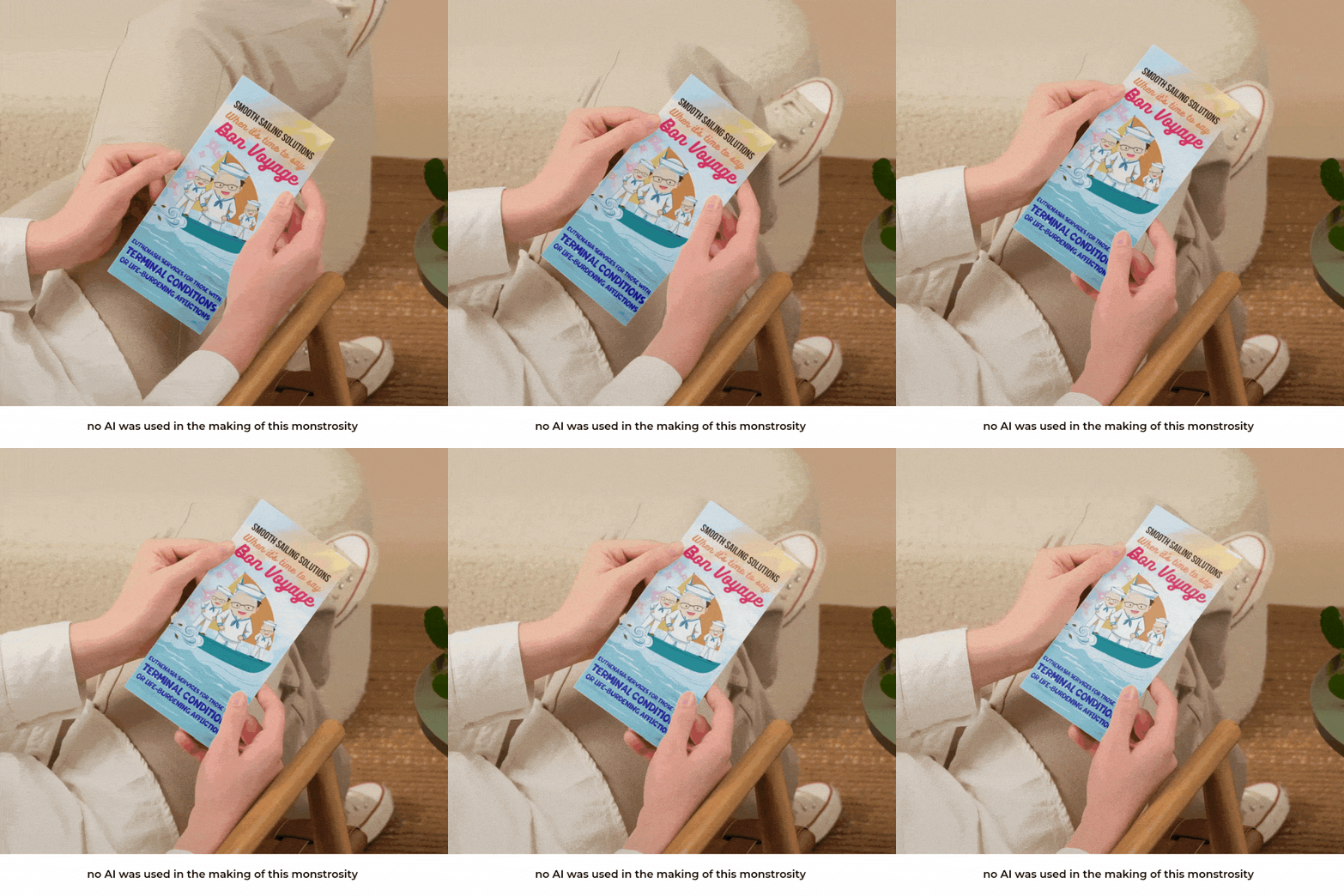
The man had a high-pitched voice and spoke quickly, explaining that he represented a new healthcare start-up called “Smooth Sailing Solutions™.” He pointed to a small sailboat embroidered on his shirt, saying that while he didn’t have time to explain all of their services, they were designed specifically for clients with disabilities like his, and that they were pre-approved by nearly all insurance providers. He then pulled out a colorful pamphlet with the same sailboat on the cover, scribbled his phone number on the bottom, and ran out to the next room to repeat his ritual.
As the Other Guy and his mom looked at the pamphlet, the Jeopardy theme music began playing at a distractingly loud volume from a television down the hall. The pamphlet had a cursive title reading, “Smooth Sailing Solutions: When it’s time to say Bon Voyage.”
In a much smaller font below it read, “Euthenasia Services for those with terminal conditions or life-burdening afflictions”.
Bon Voyage?
“Is this some kind of fucking joke!?!” his mom let out as she took the pamphlet and threw it to the side. As it flew across the bed, a paper insert fell out that made him chuckle. On it was an AI-generated image depicting a boat full of seniors wearing sailor outfits so corny it looked like Donald Duck cosplay. They smiled and waved as the boat ascended upwards into a cloudy sky.
He pointed to the image and chuckled. “You always say I look good in navy blue, you don’t think I could rock an ascot?”
His mom found the pamphlet less funny.
“What kind of treatment is euthanasia? That’s the best they can give you? The same insurance company that can’t give you the basic services you need to live just pre-approved that maybe you could just DIE? I’m going to find that man and tell him this is shameful!”
No amount of nautical nonsense could cheer up his mom, despite his very best efforts. “I always said I wanted to go on a cruise one day, and to fly one day, and it looks like this boat does both!”
“This isn’t a joke,” she quipped back.
He knew that these assisted-suicide services existed because he once saw an article about them on Facebook, but it was paywalled, so he never read it. He assumed the article was about some far away place like Australia, or Canada, or the cult land in Midsommer. Here it was showing up in his country – a country he was constantly told was great for disabled people. It seemed the country wanted him to die along with the malls.
As his mom started to storm out of the room, the nurse from earlier came in to address the yelling. “Miss mom,” she began her plea, as she often did when his mom wanted to stay past visiting hours or asked for an extra pillow, “I need you to use your inside voice so as to not disturb the other patients.”
She did not use her inside voice. “Do you know what that sick man is selling? DEATH! He’s selling death! To children! How could they – how could you – how – but – you’re a mom too! I know you are!”
His mom continued to yell, both at everyone and at no one. The vampire-euthanasia-salesman had long left, but it was clear that her rage wasn’t even truly intended for him. It was for the slimy hypothetical office guy who sent him. The nurse took the brunt of the yelling, because she was the closest person to yell at, but she barely seemed bothered.
In her much softer voice, the nurse responded. “I understand you do not approve, but these things – it’s a part of life. It’s medicine, really, and nobody lives forever. I would never suggest this stuff either, but sometimes there are no good options. Besides, your son, he’s an adult, he can read the pamphlet, and he can throw away the pamphlet, but that is his choice.”
He liked the way she emphasized his adultness, but framing it as a “choice,” made him uncomfortable too.
There’s something about the word “choice” that makes it seem as if there’s pros and cons to either side, as if the options should be carefully measured, and as if each had validity. The “cons” of his life, he assumed, were the thousands of dollars and hours that were being used to sustain his unnecessarily mundane quality of life.
It felt almost greedy to want to not be murdered by a doctor.
Still, he was fortunate enough to have his mom, and his family, and even Andrew down the hall, all of whom would obviously prefer him alive. He himself also preferred himself not dead, (I prefer him that way too.)
“Can you imagine!!” his mom was still flustered. “What if I wasn’t here, what if someone pressured you, what if–”
“RELAX, I DON’T WANT TO DIE,” he tried to project towards his mom, still laughing under his breath. “I’m not going to ‘Bon Voyage’ anytime soon.”
“I know but that’s NOT THE POINT. It’s the principle! It’s like they think this is okay, like, like, like, like, they think, they–,”
“Mom, calm down. Relax.”
“CAN Y’ALL BE QUIET I’M WATCHING JEOPARDY,” yelled Andrew from down the hall.
“I would never want those services for myself or my loved ones” repeated the nurse. “But I understand why some people would choose them, and I believe they are entitled to that decision.”
“But all life is a gift!”, snapped his mom. “What if they’re mentally ill? What if they’re a teenager? Or what if they are just having a tough time and don’t realize that the universe has a beautiful surprise for them right around the corner? We can’t offer things like this without planting these evil seeds in people’s minds telling them that this is ok.” She spoke so emotionally that her arms were swinging as if she was being puppeted by a remote televangelist. “We only get such a tiny, tiny time on this Earth. And to throw even a day of that away is worse than any vice or crime or sin.”
“Mom, it’s not about sins, it’s just… it’s complicated. I don’t want to do this stuff obviously, but I don’t know. Other people, well maybe their pain is just so bad. Remember when I had that surgery, and I couldn’t sleep for like four days because no medication would help? For some people that’s every day! And who are we, people in less pain, to say no, they need to suffer, forever, because we think it’s the right thing to do? But yeah of course, not like for kids, or like just people who are depressed or whatever. I don’t know. It’s complicated.”
His opinion went back and forth, partially because he had internalized guilt about the sacrifices his family had made for him, and partially because he never read that paywalled article. He hadn’t thought about the ways these services would inevitably be immorally pressured by corrupt economic incentives.
(I on the other hand spent the $2.99 to read it, and am aware of the many ways it has been and can be used simply to save some dollars, so I can proudly inject my take: fuck “assisted dying.” It’s evil and I hate it. In a pretend world where everyone has access to high-quality healthcare, we could theoretically debate the merits of elective mortality, but in this world we live in, it will always be used to put pennies over people, and that should not be tolerated. Ten thumbs down.)
While the three of them (and occasionally Andrew) bickered and debated about the ethics of euthanasia, the emotional temperature began to settle. The volumes of voices reached an equilibrium, but there was still a sense of unease, like at the end of a bad movie or a good play.
Still, the three in the room could not reach a consensus, and they talked in circles until long after the vampiric man had sailed out of the institution. Eventually the conversation drifted into another, the sun began to set, and everyone stayed alive for that night and many more.
Tomorrow (and every day after)
The next morning at 7:15, the same time as every other morning, he got into his wheelchair. He wished he could stay in bed a little later (like I can) but his routine was determined by the staff’s shift schedule. 8:30 was breakfast (tolerable), 12:30 was lunch (usually gross) and 5:30 was dinner (always gross). In between meals he plays on his phone, or applies for remote jobs, most of which end up being scams. After dinner he sneaks over to Andrew’s room to watch Jeopardy, gets in bed around 8pm, and prepares to do it all again the next day. On weekends, he eagerly awaits his mom and his mail, hoping the next navy blue envelope is his ticket out.
One guy, One Wheelchair
When I wake up and get into my wheelchair, it’s anytime between 6:45 and 11:30, and my meals adjust accordingly. I also play on my phone, and watch television, but I have the freedom to do much more, and I would never spend a beautiful night in this city watching Jeopardy. There are a lot of dollars and care-hours spent to make that flexibility possible, and I hope the big state insurance man in the sky continues makin’ it rain so I can keep that. I rely on these services. However, even in a relatively wealthy, “progressive” city, there has never been a year where my benefits weren’t suspended or challenged. For me, getting that navy envelope is scary, as each feels like an attack on the sparse benefits that I somehow manage to receive.
Still, each day we both wake up and do it all over. Let’s just hope that the Other Guy receives the next navy blue envelope before I do.
Steven is a designer and humor writer with Spinal Muscular Atrophy, and the creator of Squeaky Wheel Media, a nonprofit organization for disability comedy. He lives in New York City, spending his mornings drinking iced coffee and his evenings binging television and going to see musicals. As an advocate for authentic representation in media, he created The Squeaky Wheel to amplify disabled voices, bring humor to the nuances of living with a disability, and express how comedy can be used as a force of social justice.
About Rooted In Rights
Rooted in Rights exists to amplify the perspectives of the disability community. Blog posts and storyteller videos that we publish and content we re-share on social media do not necessarily reflect the opinions or values of Rooted in Rights nor indicate an endorsement of a program or service by Rooted in Rights. We respect and aim to reflect the diversity of opinions and experiences of the disability community. Rooted in Rights seeks to highlight discussions, not direct them. Learn more about Rooted In Rights.
I didn’t want to write this while angry. I thought that maybe *I* shouldn’t write it. I didn’t want to say the wrong thing or publish a half-baked thesis out of haste.
But here we are. As Philip Seymour Hoffman once said, I am compelled.
Honestly it’s a rage that I didn’t know I had inside of me. It’s white hot and black cold all at once. Chaotic wandering *and* steely determination toward a destination. To be heard. To be seen. To be.
In the aftermath of the blatantly racist BAFTAs incident – involving white Tourette Syndrome (TS) advocate John Davidson and actors Michael B. Jordan and Delroy Lindo, two of the highly praised cast members of Ryan Coogler’s groundbreaking film “Sinners” – social media has been awash with a mix of confusion and questions, misinformation and disinformation, pain and anger.
But no one’s anger (and disappointment) has been more ignored, downplayed, and dismissed than that of Black disabled folks, particularly Black Touretters.
While I am Black and disabled, I do not have Tourette Syndrome (TS). I am not writing from a place of authority (on the subject or the incident itself), but a place of deep pain.
In the first 24 hours of this troubling news, I watched Black people I respect spout some of the most harmful stereotypes about TS. I also watched complete strangers, all white, minimize the harm done and the pain and anguish of Black people – to protect a middle-aged white man. And their comfort.
Comfort.
Something that Black people, especially those of us who are multiply marginalized, seldom receive. It’s often been asked why white people are inundated with care and understanding when enacting harm while we not only rarely receive it, but are often flat out denied it.
Rushing to comfort Davidson reminds me of how white predators and abusers are treated compared to their racialized counterparts. Tarana Burke’s #MeToo movement took off near the end of the 2010s. When accusations were made public, racialized, especially Black, public figures were often more villainized, automatically believed deviant. It’s a frustrating reality, especially in a country where, so often, racialized, disabled, and other oppressed people are overly punished and even thrown into the system through no fault of our own.
What I want is a world that gives oppressed people grace. Grace does not gloss over the need for amends. It doesn’t demand continued connection or support. And it doesn’t snuff out righteous anger. John Davidson’s initial public “apology” was not only woefully inadequate, but insulting. White disabled people continue to be frustratingly disappointing. But every time I read the common sentiment “Oppressors should be treated like us,” from fellow marginalized people, I think: why would you not demand softness for yourself in this moment? Why would you want to change the world for the worse? My desire to uplift grace is ultimately not about Davidson and the BAFTAs or “cooning.” I am not Samuel L. Jackson in Django Unchained.
However, in creating the anti-carceral world I envision, I don’t want Black and other racialized predators to skirt accountability and reparation. Likewise, I don’t want white and other privileged predators automatically discarded when harm is done. Disposability politics are the antithesis of liberation. In part because, by definition, those of us who are most oppressed are the most harmed when they’re enacted.
When I imagination our future, I imagine creating a world that elevates our humanity. I do not go backwards. I do not devolve. I do not regress. I refuse to…because I know that a better world is possible. Heightened humanity can, with much practice, erode capitalism, topple fascist regimes, feed and house people, and save our oceans. When humans falter, as we often do, do we want to handle it differently? If not, then this essay isn’t for you. But, if so, we must destroy our current paradigms to rebuild healthier, more human ones.
Hope, as Miriame Kaba says, is a discipline. And hope manifested is only possible when we govern ourselves, right now, as if that world is already here.
Denarii Grace (she/they – mix it up!) is a multi-hyphenate writer and editor, singer, and long-time activist. Founder of Fat Acceptance Month, they’ve been an editor with Rooted in Rights since May 2022. She can be found on Facebook, Threads, and Instagram @writersdelite.
About Rooted In Rights
Rooted in Rights exists to amplify the perspectives of the disability community. Blog posts and storyteller videos that we publish and content we re-share on social media do not necessarily reflect the opinions or values of Rooted in Rights nor indicate an endorsement of a program or service by Rooted in Rights. We respect and aim to reflect the diversity of opinions and experiences of the disability community. Rooted in Rights seeks to highlight discussions, not direct them. Learn more about Rooted In Rights.
When I first began tutoring mathematics and statistics for students in high school and community college, I had expected the hardest aspect to be explaining formulas. What I found was that the real barriers were emotional. Many of the students I worked with were neurodivergent, including those with ADHD or on the autism spectrum. Almost all arrived believing they were bad at math and sharing their fear of it. I know that feeling well. I failed my first college math course at 17 and spent years seeing numbers as a gatekeeper rather than a language I could speak.
Mathematics education often reflects expectations that cut against how many disabled and neurodivergent students learn. Speed is treated as proof of understanding. Timed exams stand in for evaluation. Struggle is framed as deficiency rather than information about the environment or the teaching methodology. These norms did not appear by accident, they are the byproducts of an instructional culture built around uniformity, surveillance, and performance.
I realized in my early twenties that I could not learn mathematics through traditional college instruction. I began using free resources such as Khan Academy and YouTube. Without time limits or pressure, I could think through problems at my own pace. Once I realized that understanding depends on method, not speed, I began to see that the problem was never with my brain or my mind. It was how math is taught. The method and philosophy of teaching mathematics matter as much as the content itself.
Mathematics is often taught as a race toward a correct answer rather than an exploration of reasoning. This approach rewards speed and conformity instead of patience and understanding. That realization shaped how I teach others. My tutoring sessions revolve around three strategies that make mathematical thinking accessible to students who process information differently. The methods I use are scaffolding, metacognition, and reverse solving.
Scaffolding means breaking complex ideas into smaller, connected parts. If a student is learning logistic regression, I start with probability, then move into binary outcomes, and only after that to odds ratios and full models. Each layer builds upon the last. This method prevents students from feeling overwhelmed and helps them experience progress in real time. It replaces the panic of “I can’t do this” with a steadier rhythm of understanding.
Metacognition is the practice of thinking about how we think. I encourage students to slow down and reflect on the process rather than the product. I like to ask questions such as, “What does this result tell you about the problem?” or “How would you explain this to someone with no background in math?” Prompts like these help students examine their own reasoning and reveal what they truly understand. Many begin to notice that what felt like confusion was often just rushed or unexamined thought.
Reverse solving turns the problem around. Instead of starting from the question, we begin with the answer and trace how it could have been reached. This allows students to explore logic without the pressure of uncertainty. It often builds confidence in those who have internalized the idea that they cannot do math. When they can explain how a solution works, they begin to see that the skill was always there.
Taken together, each of these approaches do more than make math easier. They create room for students who have been pushed out of STEM not by inability, but rather by a system that is unwilling to meet them where they are. Many students that I have tutored and taught arrive believing the difficulty signals a personal flaw. However, once they are given time, tools, and permission to think differently, their performance changes, as does their sense of belonging. The broader fight for disability justice includes dismantling norms that confuse conformity with intelligence. Rethinking how we teach math is one piece of that work. It gives disabled and neurodivergent students the opportunity to learn without being told that their brains are the problem.
“Joseph “Joey” Colby Bernert (any/all) is a queer clinical social worker, statistician, and public health researcher. He works at the intersection of rural health, substance abuse, and epidemiological studies.”
About Rooted In Rights
Rooted in Rights exists to amplify the perspectives of the disability community. Blog posts and storyteller videos that we publish and content we re-share on social media do not necessarily reflect the opinions or values of Rooted in Rights nor indicate an endorsement of a program or service by Rooted in Rights. We respect and aim to reflect the diversity of opinions and experiences of the disability community. Rooted in Rights seeks to highlight discussions, not direct them. Learn more about Rooted In Rights