
(Junk) Journaling Toward Connection

A photo of a pile of writer Cavar's junk journals. They're situated in a light green nook, stacked on top of each other.

Sometimes (oftentimes) writing is the kind of thing we need to back ourselves into. Facing forward, diving in, especially from great proverbial heights, is simply Too Much—for those who don’t see themselves as writers and, perhaps even more so, for those who do.

As a writer, I’ve never struggled with the blank page per se. My struggle rests more solidly in the messy page, the “useless” page, or the “unproductive” page. While anxieties over whether or not my drafts will ever be worth reading remain pervasive even through books, contracts, and praise, there is also a critical space of respite in my writing life that I’d like to share with you: my “junk” journal.

I started journaling daily when I was 11. I spent all of my adolescence doing so in the simplest possible way: opening a notebook, writing some things about my day (sometimes only a sentence’s worth), signing off. It was tedious, but I’m stubborn and hate change, so I continued writing carelessly—often illegibly—through my adolescence. 

When I moved to college, I anticipated homesickness, so made an agreement with my mother to change up my journaling practice: every day, I’d write three to five things that happened that day (usually good, often small) and send her a picture of the page. It was in these moments that my

17-year-old self realized that the “solo” act of journaling was in fact a space of profound connection.

Of course, one connection that I strengthened was the one with my mother, who I was eager to form an adult relationship with after years of tension related to my psychiatric crises. But, as I wrote, there were also other, subtler connections realized between the pages of that journal. I understood the importance of my newfound friendships, the transformative impact of my now-open trans life, and my personal and creative growth in a space away from home.

This creative growth has manifested in a number of ways since my undergraduate years. Now, at twenty-six and nearly finished my PhD, each of my journals remains an archive of complaints, jokes, and vital moments of gratitude. It has also, crucially, become a house of junk. By junk, I refer affectionately to receipts and plane tickets, stickers and greeting cards, characters and illustrations cut out of packaging. Anything that can be (washi) taped into any notebook is fair game, especially if it carries emotional weight.

These pieces of junk help to accessorize my journal. They offer me the opportunity to tape and stick when I don’t feel like writing much. They also remind me of my connections to other people, my experiences both past and potential, the relationships and opportunities that not only make these journals worth keeping, but also make my life worth living.

As a disabled, Mad writer, I’ve been asked many times whether I maintain my journal as a form of catharsis for what may be paternalistically described as my “racing thoughts” and “big feelings.” While conventional “mental health” advice typically invokes the journal as a method for coping with extreme emotions or overwhelming thoughts, my experience has been quite the opposite: digging too deep into fresh thoughts and emotions is more likely to amplify a crisis than to mitigate it. When I write my feelings, I do so on my own timeline, sometimes years after a given event occurred.

Beyond this, my experiences of surveillance and institutionalization are a grim reminder of the risk I take by putting pen to paper, even now, as an adult who lives independently. For those of us who have been taught not to trust our own perceptions, or for whom journaling has at times been a requirement to fulfill “for our own good,” reclaiming the page as a space for junk can be a political act. My journal is not a confessional, but an archive of things that would otherwise have been thrown away, largely disposable things that I have instead chosen to keep and even treasure.

We are the sum of our connections and experiences. The practice not only of journaling, but of junk journaling, can help us move beyond the feelings of isolation and dread associated not only with the blank document, but within a world hostile toward disabled and Mad experiences. Yet the blank document can also pose near-infinite possibilities for those of us accustomed to stories pre-written for us, those of us aching to break out of normative frameworks of value. In this way, my journal is a supplement to the rest of my writing, reminding me that I am the one who gets to choose what I put on the page, and when, whether it’s an emotional passage, a sticker, or an old grocery list.

It’s okay to be overwhelmed by the idea of journaling, of staring down the blank page and eventually putting something on it. Rather than waiting for the perfect moment, consider grabbing a pen, tape, and some junk, just to see what happens. Even in moments of darkness, the page can be a place to document the quotidian joys and tiny artifacts life always has to offer us, and serve as a necessary reminder that we get to choose if, when, and how to tell the stories of our lives.


[sarah] Cavar (they/them) is the author of Failure to Comply (featherproof books, 2024) and Differential Diagnosis (Northwestern University Press, 2026), with genre-nonconforming writing in Kairos, The Rumpus, Transgender Studies Quarterly, Electric Lit, and elsewhere. They hold a PhD in Cultural Studies with a concentration in Science & Technology Studies from the University of California: Davis, and are interested in the politics of queercrip & transMad knowledge production. More at their website, Bluesky, and their newsletter.

About Rooted In Rights

Rooted in Rights exists to amplify the perspectives of the disability community. Blog posts and storyteller videos that we publish and content we re-share on social media do not necessarily reflect the opinions or values of Rooted in Rights nor indicate an endorsement of a program or service by Rooted in Rights. We respect and aim to reflect the diversity of opinions and experiences of the disability community. Rooted in Rights seeks to highlight discussions, not direct them. Learn more about Rooted In Rights
Finding COVID-conscious Community

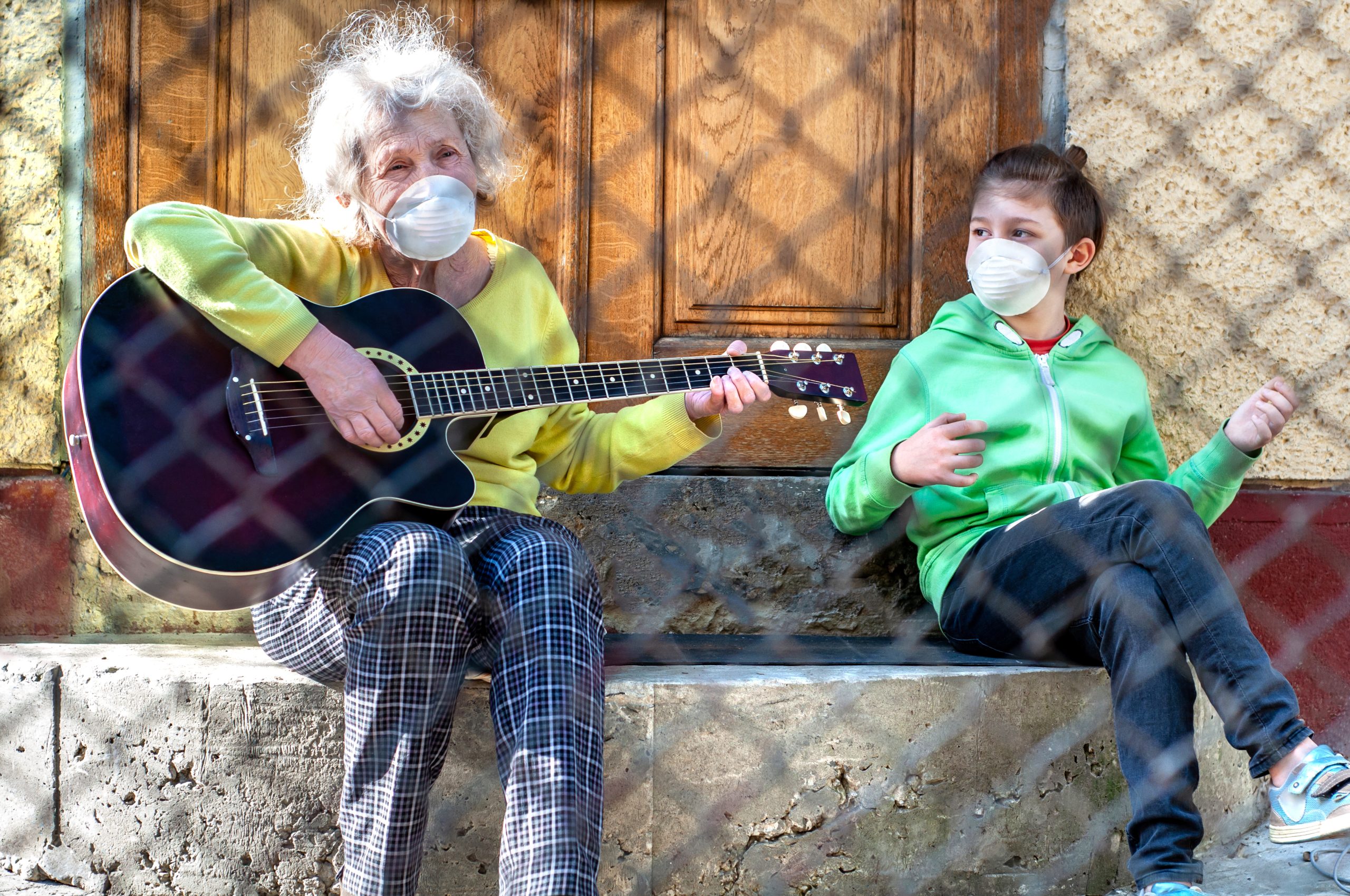
Outdoors, day. Two fair-skinned people, a white-haired elder and a school-aged child, are dressed casually as they sit on some front steps. They're both wearing white respirator masks. The elder is holding a black guitar as the younger person looks at them.

DISCLAIMER: This post is neither sponsored nor an ad.

There are many reasons why some folks never went “back to normal” in the years following 2020. Some of us are immunocompromised, have Long COVID from a previous infection, or take care of those who are at high risk. Others may simply know the risks associated with repeat infections and don’t feel like rolling the dice. Whatever your reason for practicing COVID (and other airborne illness) mitigation habits, you’ve likely struggled with finding like-minded people to connect with.

Traditional dating/friend-making apps can be a great place to start if you want to cast a wide net or live in a rural area. I’ve had success finding COVID-conscious friends using apps like Bumble BFF, as well as some other corners of the internet like COVID-conscious subreddits and Facebook groups. Of course, these are often targeted more at information sharing rather than making meaningful connections. 

Combing through hundreds of Bumble profiles only to find one person who might be a match can be disheartening. I’ve thought to myself many times before “Why isn’t there a way to filter for only COVID-conscious people?”

There’s an app for that!

The app, called Refresh Connections (referred to herein as Refresh), is available for free on Android and iOS. There is a paid premium feature, but you truly do not need it to enjoy all of its primary functions. Set up much like any other human connection app, Refresh matches you with other folks with similar interests and goals. What makes this app unique and invaluable to people who are seeking COVID-conscious community, however, is its focus on airborne infectious disease safety.

When you sign up, Refresh asks you to create a profile consisting of a short bio, a few photos, and the types of relationships that you’re interested in establishing (e.g. friendships, serious or casual romantic relationships, business/professional connections, etc.). You are then asked a few questions around the types of precautions you take and your level of potential exposure, such as your work situation, if you eat at restaurants, and whether or not you have roommates.

And then you’re in! You’ll see your potential matches and can chat using the in-app messaging platform. You can also filter by location, age, prevention behaviors, sexual orientation and gender identity (they offer a pretty robust list of self-identity options), and relationship types. The filtering system can be fine-tuned here, if desired. You can hand-pick which identities you would like to see in your matches, as well as which identities you would like your profile to be shown to. This feature can be handy for safety reasons, but seeing as the app is currently largely inhabited by queer and disabled people like myself, I haven’t personally found a need to use it yet.

This app shows so much promise, and I sincerely hope that it continues to grow, but there is a major roadblock for me: the smaller user base. In my town, there are no active users. I’ve come to accept that I’ll be using Refresh mostly for establishing great virtual connections with like-minded folks. If you live in a larger city, however,  you will likely have better luck finding local connections. I like to think of it as valuing match quality over quantity. Having fewer options to pick from, but a higher likelihood of establishing a lasting relationship (even if that relationship is long or medium distance) is invaluable, in my opinion.

I still think spreading the word about Refresh is a worthy endeavor. The more people who know about it, the more useful it can be for those like myself, who have been shuffled to the dark corners of society due to disability and accessibility issues, to find community among people who just get it.

Some other resources that I’ve found helpful in getting back to my own version of normal is utilizing masking and testing before, during, and/or after in-person meetups. There is absolutely nothing wrong with asking a friend if they are okay with wearing a mask while you hang out and/or both of you taking a test beforehand! If cost is a concern, there is a massive directory of mask blocs, which distribute free masks and COVID tests to those in need.

With the right resources, and a little bit of pre-planning, there are truly so many ways for us to stay connected and present while also protecting each other!


Harmony King (she/they) is a disability advocate, (sometimes) content creator, and a lifelong learner. Born disabled, she loves to use humor and art to call in able-bodied folks and get them thinking about their role in perpetuating ableism. When they aren’t in a pain flare, you can find them reading, writing, playing video games, crafting, or starting a shiny new hobby. You can find her on Threads, Bluesky, and Instagram.

About Rooted In Rights

Rooted in Rights exists to amplify the perspectives of the disability community. Blog posts and storyteller videos that we publish and content we re-share on social media do not necessarily reflect the opinions or values of Rooted in Rights nor indicate an endorsement of a program or service by Rooted in Rights. We respect and aim to reflect the diversity of opinions and experiences of the disability community. Rooted in Rights seeks to highlight discussions, not direct them. Learn more about Rooted In Rights
Braille and Leisure in India: 10 Years of White Print Magazine

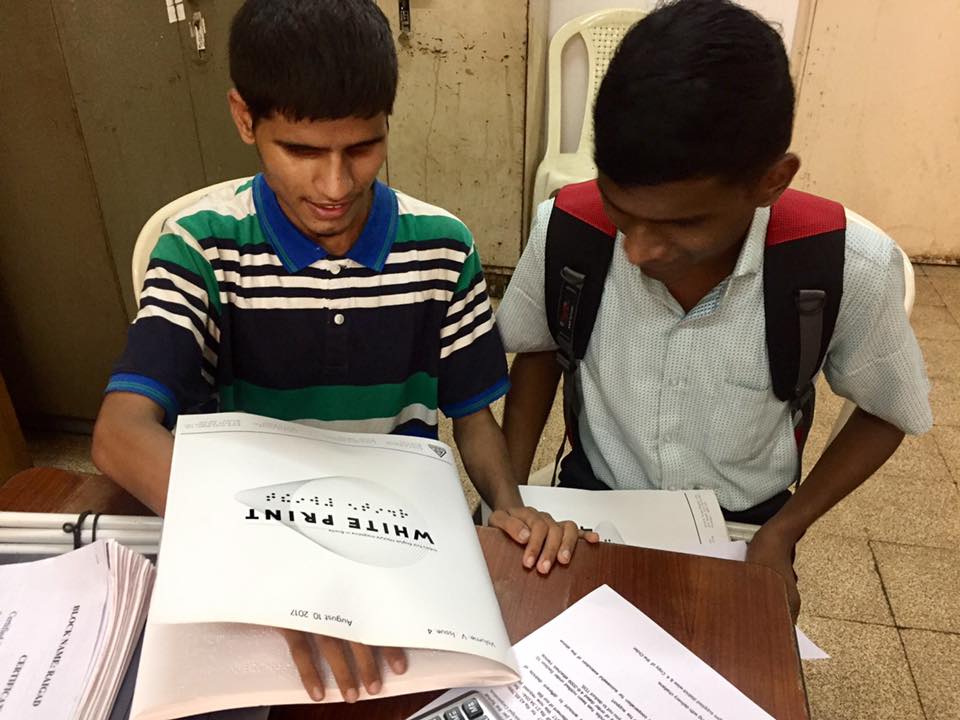
Indoors. Two dark brown-skinned Indian teens, one wearing a bookbag on their back, look down at copies of White Print mag that are located on a brown table.

India is home to more than 18 million blind people; most of us face stigma and discrimination on a day-to-day basis. Apart from inaccessibility and lack of awareness and funds, most blind people find it hard to get a good education or employment opportunities. 

Not many among India’s blind population have the means to buy laptops and smartphones; nor do many of us have access to technology like screen reading software and apps like Audible. While there have been some free audiobooks and textbooks in braille, there hasn’t been anything much in English braille that the blind could read for leisure

Upasana Makati, a former PR professional, loved reading the newspaper every morning. One day in 2012, she suddenly wondered what the blind in India read for leisure. After months of research and conversations with blind people, she realized that there wasn’t any Braille lifestyle magazine in English in India and decided to start one in 2013. The question she pondered was why shouldn’t the blind have access to leisure reading for fun like the sighted do. This was the beginning of White Print magazine, which celebrated 10 years of publishing in May of this year. 

“It feels surreal to have completed a decade. I started at the age of 23 and, during this ten-year-long journey, I have found people who have told me this will not work even for a couple of years. When I spoke to advertisers initially, many people told me it’s not going to work for you.  From that point to completing ten years now without being able to get any sort of massive investment and so, being bootstrapped, it feels phenomenal,” Makati says. 

Due to a lack of funding, she often wrote the content herself and printed the magazine at her own cost at the braille press of the National Association of the Blind, in Mumbai. Printing a Braille magazine is expensive, too. For White Print, the cost of printing has risen from Rs 0.50 ($0.006) per page to Rs 3.00 ($0.036) in the last few years. 

Although White Print had a few innovative brand collaborations in the past, post-pandemic advertising revenue has dwindled. However, Makati is determined to keep publishing the magazine because of the readers, some of whom have been reading White Print since its inception and look forward to it every month.

“Funding is still challenging and printing a Braille magazine is expensive and we’re charging only Rs 360 ($4.34) for twelve issues a year from our individual subscribers. Although some blind people have access to audiobooks, I feel blind people too should have the option to choose between reading a braille copy today and listening to an audiobook tomorrow. Just as sighted people have the option to choose between print, e-books, or audio,” she says.

For a long time, people with disabilities in India have been either seen as sources of inspiration or sympathized with. There is a lack of empathy and understanding. Makati still gets asked why she runs a braille magazine in this age of digital media. She feels this idea comes from a very ableist point of view and would then ask why the sighted still buy books or magazines! 

Dr. Divya Bijur is a physiotherapist from Mumbai; she’s been blind since birth. She has been subscribing to White Print for the last seven years and finds the magazine insightful. Bijur feels White Print has helped her keep her connection with Braille. “I love reading Braille and have studied in Braille since the age of six. White Print covers diverse topics: from music, travel, parenting, nutrition, food, and environment to serious issues facing the world, and I think the work is great because we get to read various reading styles. The quiz is also amazing,” she says.

Although White Print is a lifestyle magazine, Bijur feels it encompasses her life by giving her a peek into the happenings of the world. “Reading generally cheers me up, and I feel ecstatic when I’m reading braille. White Print has been a great companion and at times I feel like throwing off my earphones and just being in peace and reading without sound, and that’s where braille comes to my rescue,” she adds. 

Satish Nikam is a 75-year-old blind retired senior from the state of Maharashtra. He couldn’t study beyond ninth grade owing to trouble in arranging for scribes for his examinations and inaccessibility in general. However, he had always loved reading and learning new things. After working as a telephone operator at a sugar mill for many years, he retired in 2008. 

“I have been reading White Print since it started publishing in 2013. I receive a monthly pension of Rs 900 ($10.81) only and do odd jobs even at this age to sustain myself and my wife. I often couldn’t pay for other materials in braille because printing in braille is expensive. I subscribe to White Print magazine and requested Ms. Makati to let me pay the subscription in installments or consider a concessional rate. Knowing the situation, Ms. Makati hasn’t charged me anything for all these years. The magazine carries articles on a variety of topics and opens up the world for a blind person like me. Although my English is not very great, I have learned a lot from White Print. There are articles on gardening, travel and culture, and so much more. And it gives us, the readers, a different kind of energy and joy,” he says. 

White Print currently has a reader base of 10,000 blind people. Makati feels braille literacy is important for the blind even though many of them are increasingly learning the use of screen readers. “Sighted children are still taught with physical books and taught how to write in cursive or write using pencil and paper,” she adds.

Before the pandemic, Makati had collaborated with several brands to create interesting braille advertisements for the magazine. As advertising is mostly visual and depends a lot on color schemes, design, photography, and infographics, it was something completely new and creative for the brands to think of advertising in Braille. 

“Raymond was the first company that we collaborated with. In October 2013, we had Coca-Cola advertise with us. They inserted an audio ad in the magazine which played a jingle as the magazine was opened. This musical card-like ad was very exciting for the readers as well because they felt a brand had done something specifically for them,” Makati says. 

Sandesh Bhingarde is the founder of a Mumbai-based nonprofit organization called Team Vision Foundation. This voluntary organization works towards empowering visually impaired students in different ways and conducts blindness sensitization workshops. 

“We have been subscribing to White Print magazine for more than a year and a half now. I feel the braille magazine is important because while working with the visually impaired, we’ve found they are missing out on reading and writing. We encourage the students to read in braille because, in many instances, blind students don’t know the spellings of words because they absolutely miss out on reading,” Bhingarde says. 

While there are a few braille magazines in other Indian languages, there was a lack of Braille magazines in English. Students who use screen readers or use text-to-speech and autocorrect are improving their spelling by reading White Print, Bhingarde feels.

As White Print has entered its eleventh year of publication this year, Makati wants to spread the pleasure of leisure reading through braille literacy among a bigger number of blind Indians. 

Just as every sighted child begins their schooling with pen and paper, braille as a script does the same for the blind. If a blind person does not have access to leisure reading via braille literature, their education and growth remain incomplete. Although screen readers like JAWS or NVDA have made it possible for the visually impaired to read, write and access the internet, braille remains the first step towards literacy for the blind. White Print has been trying to bridge the huge gap in the availability and accessibility in braille literature in India for more than ten years; I feel this is an important step towards enriching the lives of the blind in India.


Arundhati Nath (she/her) is a visually impaired independent journalist, content writer, and children’s author from Guwahati, India. Her work has been published in The Guardian, BBC News, Al Jazeera, CSMonitor, and many others. She can be reached at natharundhati@gmail.com and her published work can be viewed on her website.

Rooted in Rights exists to amplify the perspectives of the disability community. Blog posts and storyteller videos that we publish and content we re-share on social media do not necessarily reflect the opinions or values of Rooted in Rights nor indicate an endorsement of a program or service by Rooted in Rights. We respect and aim to reflect the diversity of opinions and experiences of the disability community. Rooted in Rights seeks to highlight discussions, not direct them. Learn more about Rooted In Rights