
Living Disability Justice and Fat Liberation in Such a Time As This

A march of disabled activists in power chairs, scooters, wheelchairs, and walking holding signs. A sweatshirt reads "Fatties Against Fasicsm." Signs read, "No Body is Disposable," "Housing Injustice is Anti Blackness," "Housing Justice is Disability Justice." Disabled activist and ancestor Stacey Park Milbern is in the center of the photo.

I came to Health at Every Size (then body positivity, now fat liberation) in early 2013. I was in my first year of grad school – one of those rare creatures that lived on campus. I didn’t realize it initially, but listening to the body stories of my roommate – also a Black grad student – began to radicalize me. Diet and weight loss cultures sounded like nonsense. I didn’t have the language for it at the time, but I viscerally felt the harm they were causing – in her and in myself.

When I started Fat Acceptance Month (FAM) in January 2019, I envisioned it contributing to a larger paradigm shift. I wanted as many people as possible to benefit from the mental reset that had changed my life and politics. I wanted a better world and FAM was my way of reimagining its future.

Of course, the world was significantly different then, just seven years ago. Fat activism was different. Disability Rights and Justice activisms were different. And deservedly so.

But as the systems that choke us evolve, pivot, and expand (to excess), it has become increasingly clear: so must we.

Anyone paying attention has observed the rewinding of progress. Even former Vice President Kamala Harris, fairly center-left, declared that “we are not going back.” From trad wife content and DEI rollbacks to the apparent return (with a vengeance) of both heroin chic and the r-word, we are being reeled back in – to an environment more comfortable for the most powerful. Much of our modern world is steeped in centuries of colonization, imperialism, capitalism, and white cisheteropatriarchy. And, now more than ever, they don’t want us to forget it.

So how do we stand up and fight back? How do we practice the discipline of hope?

I believe that the linchpin of liberation movements is body autonomy. You can’t have abortion and reproductive rights, trans rights, intersex rights, workers’ rights – and indeed disability justice and fat liberation, among others – without an inherent human right to the very vessels that allow us to experience life. We resist the rise of authoritarian movements by centering autonomy (which is separate from individualism).

However, in my almost 20 years of experience as an activist (community educator), I find most movement work lacking in its understanding of both disability rights/justice and fat liberation.

Renowned poet, singer, musician, and author Gil Scott-Heron famously said, “The revolution will not be televised.” Most people interpret his declaration to mean that The Powers That Be won’t allow it to be properly documented. That has certainly proven to be true in all the awful ways. However, he stated that his meaning was actually about the fact that revolution begins in the mind, with an idea. When your mind changes, your values and politics change, your words change, your actions change. And, in time, the world too changes.

So I call on you to make a change (or, perhaps, build on your progress). This is about more than planning events that require masking (which you should be doing!) or advocating for larger seats on planes (which you should also be doing!).

If you’re reading this, you’re already off to a good start. But changing your mind almost always means challenging your assumptions – the ideas you already have, absorbed from a society that hates both disabled people and fat people. It requires digging deep. What beliefs do you continue to hold on to? Perhaps you think that, in an ongoing pandemic, the most vulnerable just have to fend for ourselves. Or maybe you believe that it’s still inherently good for larger-bodied people to intentionally lose weight.

Following the right activists and influencers, reading the right books, watching the right documentaries, joining the right groups won’t allow our movements to evolve, pivot, and expand if we’re not actually internalizing the new, challenging information we’re introduced to. It requires radical honesty: about our fears, our prejudices, our privilege (where applicable), our self-hate (where applicable), our ignorance. This is the work. It is hard, painful, but it is the only way that we all truly get free.

I cannot attest to the changing of the world just yet, but this is my testimony. One day, near the end of 2012, I had an idea. That idea led me to a Facebook group. That group introduced more ideas. My values and politics began to change. How I spoke, how and what I taught shifted. 90s R&B girl group En Vogue said it best: “Free your mind and the rest will follow.”

Denarii Grace (she/they – mix it up!) is a multi-hyphenate writer and editor, singer, and long-time activist. Founder of Fat Acceptance Month, they’ve been an editor with Rooted in Rights since May 2022. She can be found on Facebook, Threads, and Instagram @writersdelite.

About Rooted In Rights

Rooted in Rights exists to amplify the perspectives of the disability community. Blog posts and storyteller videos that we publish and content we re-share on social media do not necessarily reflect the opinions or values of Rooted in Rights nor indicate an endorsement of a program or service by Rooted in Rights. We respect and aim to reflect the diversity of opinions and experiences of the disability community. Rooted in Rights seeks to highlight discussions, not direct them. Learn more about Rooted In Rights.
Fat Stigma and Limited Mobility: The Body Changes, But What Does It Mean?

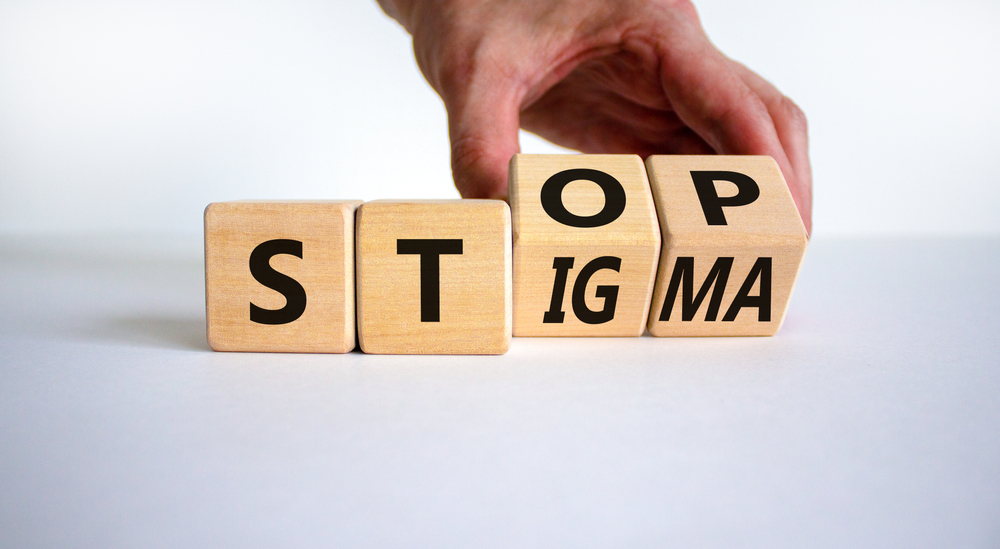
On a white background, a fair-skinned hand holds two of four wooden die. The die have letters on them that read, "Stop Stigma."

CONTENT NOTE: the writer uses the word “fat” as a neutral descriptive term—like tall, blonde, or Deaf. She warns readers to be careful with that word in public though. Most of the world still hears it as an insult. That deserves more discussion, too. Also, allusion to ableist language (in context)

He had taken yoga classes from me nearly twenty years ago and we just ran into each other in a store. He noticed that I’ve gotten fatter and slowed down a bit. (We were walking, so he could see my limp.) He was happy to see me; we took a moment to catch up.

First, let me be clear that I was always fat. I was fat and athletic, fat and strong, fat and graceful. I was a stereotype-buster when it came to the myth that fat people don’t exercise and can’t know enough to teach anything related to the body. Now, I’m a fat(ter) 55-year-old lady with a limp. Arthritis and a few other issues have slowed me down. That yoga student was jovial; I don’t think he meant to disparage me when he looked me up and down and said, “Wow, you were a really great teacher. So impressive. I guess you’re not teaching anymore though.”

He said it in that “I guess you don’t run marathons these days” “joking” way that someone might say to a wheelchair user. I mean “obviously” you can’t participate in a marathon because you can’t run. Neither comment is funny. Of course, marathon athletes can move it forward in a whole lot of ways. And yoga? “Hey!” I said. “It sounds like you haven’t taken enough classes if you think yoga’s about the body. Of course I still teach. My practice looks different though. I’ll bet yours does, too.”

He chuckled and agreed that his body isn’t what it used to be. No one’s body is the same after twenty years, but he may have just been trying to cover his embarrassment. For all I know, he might have the strength and power I last saw in his body. But why would this matter?

It matters precisely because fat stigma limits people—and not just fat people, though obviously we are the most impacted. Like ableism, it limits all of us. And it’s not just that people don’t love their bodies enough! Stigma is a problem at the unconscious symbolic level. That is, bodies already carry meaning. Of course, many fat (and disabled) people are active and do regular stuff day in, day out. But because the very sight of a large body carries deeply embedded stereotypes, exceptions must be made.

Those stereotypes limit slender people as well. Many who are not fat or disabled also don’t enjoy being outside in a bathing suit, being in photographs, or eating a slice of pie in front of others. We can all be a bit more free by removing stigma on everyone.

I became the fat unicorn—capable, graceful, athletic. In short, impressive to most because fat hatred is the rule of the land and fat people, despite being regular human beings, are not supposed to be smart, interesting, sexy, into fitness, etc. My default category, in the eyes of most onlookers, is fat, lazy, “unintelligent,” and undisciplined. I can opt out of those things, temporarily, through conventionally “praiseworthy” behavior.

But what about that limp? Sociologist Erving Goffman helped us to understand “spoiled identities” in the 1960s. Some traits limit a person’s social chances temporarily, others more permanently. For instance, not all limps are seen in the same way. Consider the limp of a soldier in uniform vs. a fat lady getting in an elevator vs. an elderly person with a cane vs. a young person on crutches with a foot wrapped like an injury. Any of these people may be disabled due to heroic, foolish, or mundane injury; their disabilities may be temporary or permanent. How they are treated is already coded into the rest of their appearance.

I have been fat all of my life; depending on what I’m doing, I’ve been seen as a cautionary tale, an inspiration, an anomaly, and a liar. (“YOU are a vegetarian?”) Discrimination is clearly not good for fat people, but it keeps everyone else either scrambling in avoidance or feeling superior—focusing a lot of attention on not being fat. What a waste of human potential.

Now that I’m an aging fat lady with a limp, I can report that I enjoyed life more being seen as beautiful and capable (and fat) than being seen as fat, slow, and incapable. My ability to highlight “unspoiled identities” has shifted because the triple burdens of disability, aging, and fatness are too great to interrupt. They affect me intersectionally.

Anyone with a visible disability might be dismissed as damaged or less than, but being fat adds a whole different dimension. When people see me limp, they assume that I’m disabled because I’m fat—specifically that I’m lazy and inactive and now I can barely walk. It’s disgusting to them, no longer even pitiable. Certainly not capable and deserving of care.

Perhaps my blanket statement about how “people” see me seems unfair. “We’re individuals!” you might say. Of course, and I don’t think everyone is just being mean. But the cultural meanings our society already holds make it harder for individuals to act differently from the norm. Some are easier to respect than others—just by looking at them—unless we make the effort to act otherwise.

The good news is that we can make the effort and use discernment, even when stigma is internalized. Some may be reading this right now with the belief that fat and disability aren’t in the same category. “Just lose weight!” The truth is that so many factors make dramatic weight loss impossible for many high weight individuals. But does that diminish our humanity?

We also need to notice when our own exclusionary sentiments are pointed inwards. Maybe it’s easier to feel worthy of care and support because of your disability if you’re not fat, if you eat “well,” exercise, or are extra cheerful. Or, or, or.

When we talk openly about how personal discomfort and disgust regarding whole groups can lead to fewer rights for those people, we become more capable of disrupting those unconscious biases. Disabled and fat people both deserve dignity and respect; the same applies to stereotypes about race, gender, etc. People need to realize their “common sense” perceptions are often a problem and then feel empowered to do better.


When judgmental thoughts come up, it’s possible to mark them with the conscious mind and then revise. Then the revision must become practice. It’s not enough to believe that cigarette-smoking, pizza-eating, beer-drinking curmudgeons need love too if you also think that somehow you’re only lovable if you’re a constant hope-seeking, sparkling conversationalist. You are worthy of care and support regardless of what you do, how you act, and what you look like. And so am I.


Kimberly Dark (she/her) is a writer, sociologist, and storyteller. She is the author of Fat, Pretty, and Soon to be Old: A Makeover for Self and Society and Damaged Like Me: Essays on Love, Harm, and Transformation. Learn more and sign up for The Hope Desk, a free newsletter, on her website.

Rooted in Rights exists to amplify the perspectives of the disability community. Blog posts and storyteller videos that we publish and content we re-share on social media do not necessarily reflect the opinions or values of Rooted in Rights nor indicate an endorsement of a program or service by Rooted in Rights. We respect and aim to reflect the diversity of opinions and experiences of the disability community. Rooted in Rights seeks to highlight discussions, not direct them. Learn more about Rooted In Rights