
Impassable Sidewalks Turn Curb Cuts Into “Decorative Accents”
It’s easy for the able-bodied to take getting around for granted. Most people can drive, walk, or take public transportation with relative ease. Not so for many with disabilities.
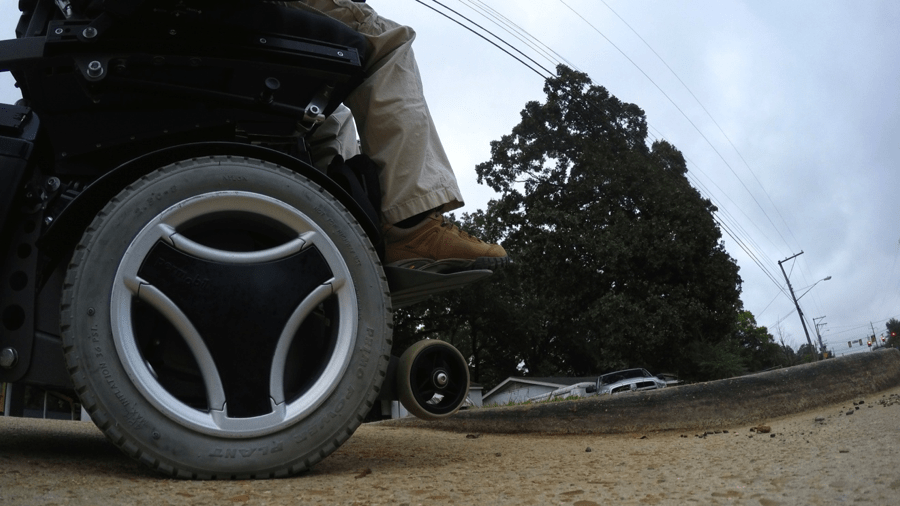
In light of Rooted in Rights’ #CrappyCurb campaign, I’d like to highlight one of the points I make whenever I speak: “Transportation is only as good as its weakest link.” It does little good to have an accessible bus when one has no safe means to get to it, and no place to wait or board. For people like me, that means waiting in the driveways of businesses for a bus, riding long distances in the street, or worst of all, staying home. It’s hard to describe the stress of staring down motor vehicle traffic, hoping that they aren’t texting or distracted in any way. Even more frustrating is the fact that I gave the city a list of high-priority areas to fix back in 2008, which was mostly ignored.
The Americans with Disabilities Act (ADA) overarching goal was to integrate people with disabilities into the communities of their choice. It did so by mandating that public entities develop a self-evaluation and transition plan by July 26, 1992, and to complete those upgrades by January 26, 1995. Many jurisdictions didn’t comply, and their sidewalks/bus stops remain unusable.
The Federal Highway Administration (and secondarily the Department of Justice) oversees compliance with the ADA in public rights-of-way. “The primary purpose of the Federal Highway Administration’s (FHWA) Americans with Disabilities Act (ADA) program is to ensure that pedestrians with disabilities have opportunity to use the transportation system in an accessible and safe manner.” So, it boggles my mind that sidewalks themselves are considered “optional” under the ADA. I don’t think anyone demands sidewalks on infrequently traveled rural streets, but to omit sidewalks on busy urban roads, as we do here in Mississippi, violates the very essence of the intent of the law.
It also imperils our society’s most vulnerable citizens, many of who are dying. According to Smart Growth America’s report, Dangerous by Design 2014, there were 47,000 preventable pedestrian deaths from 2003-2012. That is sixteen times as many people as died in natural disasters during the same period. A disproportionate number of those fatalities were older adults, people of color, and children.
In recent years, some jurisdictions (my hometown of Jackson, Mississippi in particular) have interpreted FHWA regulations to mean that it is perfectly acceptable to resurface streets and add curb ramps without bringing the rest of the sidewalk into ADA compliance. The sight of a brand new curb ramp leading to a dilapidated, obstructed pedestrian route is hard to believe. No one would resurface a street but leave obstacles to motorized traffic. People would be outraged! So, why is this acceptable for pedestrians?
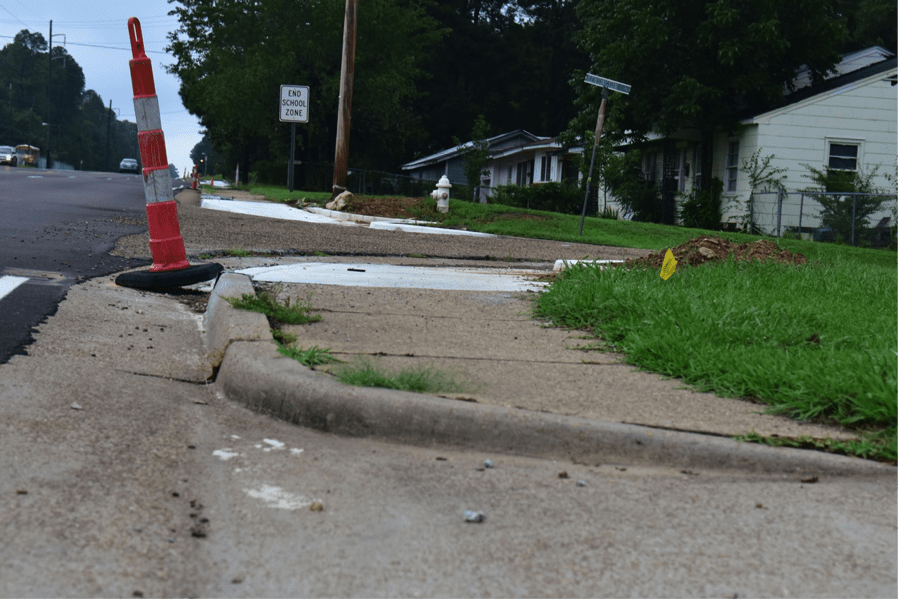
I’ve photographed curb ramps that are little more than “decorative accents” in an otherwise impassable sidewalk that isn’t safe for a mountain goat, much less a person with disability. Wheelchair users use such ramps only to find an obstacle down the sidewalk. We have to backtrack, feeling like a “rat in a maze.” My friends and I call these “sucker curbs” for just that reason. Of course, the consequence is that wheelchair users and others are forced to stay home or ride/walk in the street. I will admit, these ramps do provide the appearance of access to the general public, who don’t know better. Perhaps that’s the goal: make it “look good.”
To the knowledgeable, adding curb ramps to an obstructed sidewalk insults the intelligence, defies common sense, and can only be interpreted as passive-aggressive behavior. If this is what passes for ADA compliance, I suggest that those responsible (all of them) get in a manual wheelchair and try using their new “creation.” For our part, we need to rise up and make our voices heard! That includes peaceful protest but if need be, civil disobedience of the type made famous by ADAPT. Remember President George H. W. Bush’s words when he signed the Americans with Disabilities Act into law: “Let the shameful wall of exclusion finally come tumbling down.” Well, it hasn’t yet. It’s up to us, people with disabilities, to bring down the wall. We’re up to the task. Most of us are used to surmounting obstacles, breaking stereotypes, and exceeding expectations. We simply need to relight the flames of determination that got us engaged, brought us into the streets, and led to the passage of the ADA.
About Rooted In Rights
Rooted in Rights exists to amplify the perspectives of the disability community. Blog posts and storyteller videos that we publish and content we re-share on social media do not necessarily reflect the opinions or values of Rooted in Rights nor indicate an endorsement of a program or service by Rooted in Rights. We respect and aim to reflect the diversity of opinions and experiences of the disability community. Rooted in Rights seeks to highlight discussions, not direct them. Learn more about Rooted In Rights

Hello Scott Crawford,
This is a very insightful and necessary post! I have seen many of these examples of curb cuts leading to inaccessible sidewalks and so forth. I would also like to mention that, while installing a curb cut is an attempt at disability, these efforts are somewhat nullified and voided by leading to inaccessible sidewalks.
For instance, small towns, rural ones, like the one that I spent the majority of my childhood in, did have sidewalks; however, they were so poorly maintained that they commonly constituted thin pathways of cracked concrete that were overgrown with grass and weeds. They were not even and were barely wide enough for assistive devices in general. This meant that I was confined to my house pretty much all of the time.
The winters also present significant mobility challenges, as it is not routinely enforced that these areas are maintained in any way. I have actually had situations where I couldn’t even tell that there were curb cuts on sidewalks because the snow was piled so high. Accessible parking spaces tend not to be shoveled properly, either where there is at least 6 or more inches of snow to clog up wheel tracks or so much ice and slush that a person who struggles with mobility at all risks falling just by walking on it.
This calls to mind the parking lot of my physical therapy clinic. Here, this business makes money off of the therapeutic services it provides to individuals likely struggling with mobility, while their parking lot is a steep and snowy ice rink. Theoretically, a person could break their leg in the parking lot of the very place tasked with helping them regain desired ambulatory goals!
Another strange example of this is one of the buildings on my college campus that made traveling by the stairs immediately available as soon as you walk through the entrance, but subtly discouraged and prevented people from using the elevators by putting them in a hallway guarded by prohibitively heavy doors without automatic door openers.
The fact that physical structures are there to make accessibility possible is a necessary first step, but the installation of things does not relieve responsibility for total compliance.
Keep on keeping on!