
How Much Has the Americans with Disabilities Act Positively Impacted College Students?
The Americans with Disabilities Act (ADA) has made great strides in equal access, but it has not accomplished nearly enough. As a recent graduate, I experienced first-hand the dichotomy between how the ADA has positively impacted the college experience, and where it is falling short.
Our disability resource center is located in the basement of a building in the center of campus. It is a quiet, non-stimulating environment with comfortable couches and staffed with counselors. However, the execution of ADA policy is a bureaucratic nightmare. Students frequently complain of the complicated process of testing accommodations. Much of the initiative is left to the student, and they must make their request at least 10 business days before the test. What are they to do if a test gets moved just a week prior?
Campus events often require 3 business days for accommodations, which is fine if you’re not spontaneous at all. Upon receiving a notetaker request, the resource center sends out a mass email asking the student’s classmates to volunteer to share their notes. The majority of students will dismiss this email, saying that the disabled student is “lazy” or “taking advantage of smarter people.” Students who request a notetaker find that their request goes unfulfilled, not because the ADA itself failed them, but because the ADA cannot force students to volunteer to support their peers.
The ADA will set standards for buildings, but it won’t enforce them on campuses where buildings are so old they’ve become historical landmarks. Colleges will list disability resources on the class syllabus, but the ADA won’t require them to verify that the information is still accurate since it was last updated in 2008.
The ADA will often provide assistance with campus housing accommodations. If you’re an autistic student, the ADA will enforce a request for a single room on the grounds of full participation and necessity for daily functioning. It won’t, however, give your accommodation priority over the football team’s reserved studio apartments, nor will it guarantee that your window won’t face the busiest street on campus. The ADA will not gift you a Resident Advisor with the proper training on how to interact with autistic people. And it will not provide you any protection for when your suitemate says “you don’t look autistic.”
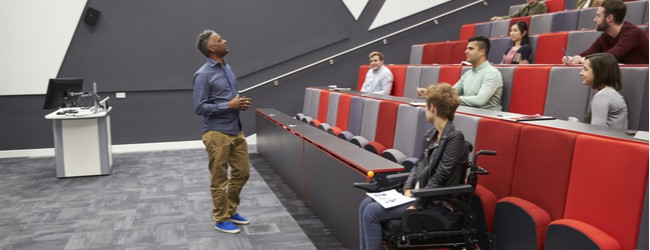
The ADA will mandate that your classroom be accessible. It will make the college provide wheelchair accessibility, an interpreter, and CART captioning, but it won’t make you feel less awkward about being the only disabled person in the room. It won’t change how you’re called on to represent everybody with a disability or how none of the course material includes voices of prominent disability activists.
The ADA has provided support for disabled college students, and I thank all the activists before me that we are celebrating its 27th anniversary. Unfortunately, its accommodations and protections have been met with apathy and upheld with underwhelming policies. The laws are in place; now it’s time to change attitudes. Because of this, I will continue to use my college experience to continue my fight for disability justice.
About Rooted In Rights
Rooted in Rights exists to amplify the perspectives of the disability community. Blog posts and storyteller videos that we publish and content we re-share on social media do not necessarily reflect the opinions or values of Rooted in Rights nor indicate an endorsement of a program or service by Rooted in Rights. We respect and aim to reflect the diversity of opinions and experiences of the disability community. Rooted in Rights seeks to highlight discussions, not direct them. Learn more about Rooted In Rights



Hi Lindy Treece,
I know this comment is late in coming, but I do feel the need to praise such a valiant effort for inclusive education as you have put forth. Like you, I am a person with disabilities who has also graduated from a college program; because of this, many of the experiences you spoke of in your post resonate with me.
I do agree with you that the ADA is caused for celebration and has enriched the lives of people with disabilities in some important ways; however, it’s presence and the efforts made to enforce it have not necessarily improved the conditions of people with disabilities as students of higher education. While the creation of the ADA has indeed increased disability awareness, it has not been as effective as it could or should be in college circles and university departments.
For instance, accommodations processes are lengthy and limited. While the ADA may require only that they be there at all, it does not ensure the effectiveness of these processes for students. For me personally, accommodations requests were fairly easy to file, and increasingly so as my time at the university progressed, the advanced notice of times required to respond to these requests were endlessly problematic for me. For instance, testing accommodations may require up to 10 business days for a response to the request, which leaves students that need these accommodations in the lurch for rescheduled test days and in perpetual fear of the dreaded pop quiz.
As my disabilities are physical and affect my mobility, getting transportation to and from classes were significant concerns the entire time I was there. I was told that the primary focus of the Disability Services department was testing accommodations. As I was unable to drive to get to classes or test sites, my needs went beyond these.
After regular communication with the department about my access needs, I was provided with the accommodation to ride the public bus service to ride to and from classes. This required me to call a week in advance to schedule transportation to and from classes and pretty much eliminated participation in any college activities, aside from the ones my friends and partner could take me to.
I frequently had to arrange rides that would allow me to get to class about an hour early (merely showing up on-time would mean that I couldn’t get a seat close enough to the whiteboard at the front of the room or with enough space to navigate with my assistive device) and leave as soon as class finished, with no ability to stay after and ask my professors questions about the material.
Despite the requirement of curb cuts, people (both nondisabled students and staff) would block these while they ran into the building for coffee or made for easier parking of heavy vehicles. At the same time, road and lot conditions were often plowed in such a way as to make wheelchair usage difficult if not impossible.
Old buildings that were not built with accessibility in mind had accessibility features added, but because they were not architectural, they were often inadequately maintained.
And, as you pointed out, every class syllabus for every course that I ever took had a section about disability accommodations, putting the entirety of the responsibility on students to secure these, even if they were recurring. Furthermore, I noticed that these disclaimers typically were only to refer to the Disability Services department, not anything about the course treatment of the disability. To me, this communicated an avoidance of disability identity as a whole.
This more indirect form of ableism was also reflected in the ways that course material, structure, and instructors avoided disability perspectives and contributions. Noticing the appalling lack of appreciation for these views and viewpoints, I would use my own efforts to give voice to disability rights issues. These were met with mixed success and even served to tokenize me.
Higher education may very well be farther along than it used to be, but it still has a long way to go.
Keep on keeping on!