
The Disabled Ingenuity of an Occasional Wheelchair User
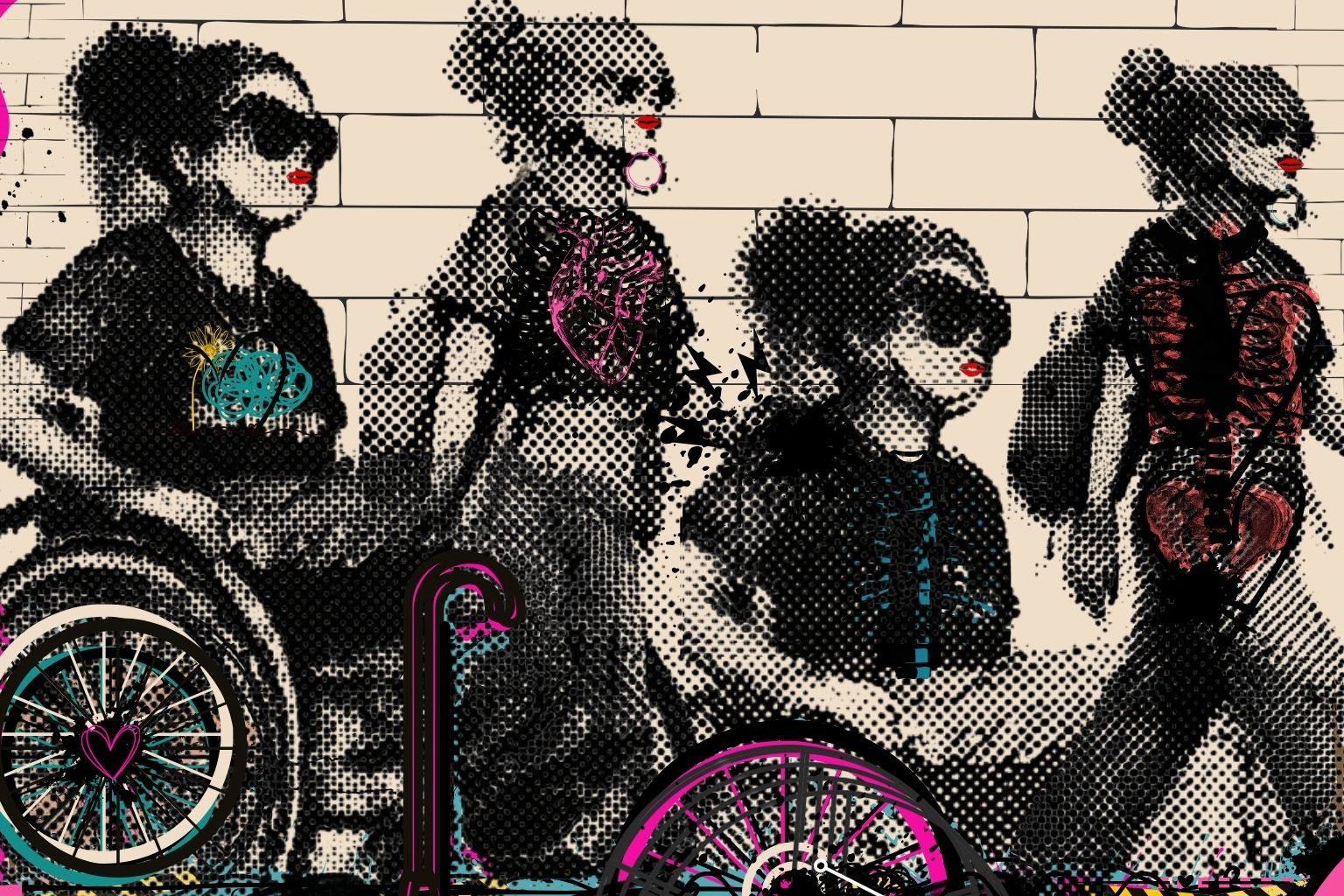
Image Title: Fluctuating Belief
Image Description: A mixed-media illustration of halftone figures composed of dense dot patterns evokes the pins-and-needles sensations associated with multiple sclerosis, rendering the body as a field of shifting signals and feelings. Set against a brick wall that gestures toward public space, and layered with anatomical imagery and wheelchair-like wheels, the composition reflects fluctuating mobility and the instability of visibility where disability is often misread or challenged, and access is granted after proof.
Access does not begin when a body collapses. It begins when people with disabilities are believed without verification.
My body has never fit neatly into a single category. It is unpredictable by nature. But in a world built on rigid systems of classification, inconsistency is often mistaken for dishonesty. Because of that, I am constantly adapting—not only to my body, but to other people’s expectations of disability, especially when mine can be invisible.
Once, I sat near the front of a bus, in seats designated for older adults and people with disabilities. I sat there for a simple reason: my legs were going to give out. When an elderly woman boarded, she stopped in front of me and began loudly chastising me, explaining what those seats were “for” and who they were meant to serve. According to her, I was not entitled to them.
Of course, I didn’t look like I needed them. At least not in a way she could recognize.
I was unmoved.
I refused to get up or explain that I have Multiple Sclerosis; that I was exhausted, that I feared my legs might buckle at any moment. I did not owe her—or anyone—a medical disclosure in exchange for rest.
Mobility is frequently misread. I do not move between “disabled” and “non‑disabled” as fixed states. I live across a range of changing capacities. Fluctuating disability becomes institutionally legible only when bodies conform long enough to diagnostic, bureaucratic, or narrative expectations.
My body doesn’t always stabilize long enough in that way—unless I am using a wheelchair. And even then, the clarity is conditional.
Because of this, I plan for access based on my worst days, not my best. Especially when traveling, I request accommodations to ensure I make it to my gate—using a wheelchair to move through the airport efficiently and stably. I do not advocate for special treatment or an exception to the rules; I only ask for flexibility—the very thing that makes participation in public life possible.
If I am seen standing or walking after using a wheelchair, I risk being questioned, accused, or embarrassed for adapting. This is one of the central contradictions of ableism: we are expected to conform to static definitions of bodies that are anything but.
I teach remotely now, not as a convenience, but as an access measure that allows me to continue working without risking stairs or unreliable elevators.
Since the pandemic—after multiple COVID infections—my health has never fully recovered. I can anticipate its ebbs and flows. Some days I need a mobility aid; others I do not. That variance is not fraud. It reflects shifts in stamina, cognition, balance, and pain.
What others read as episodic is, in fact, disabled ingenuity: embodied knowledge of my limits, energy, risk, and safety. I know my walking bandwidth intimately—even on days when I have none left for explanation.
Disability rights and justice are not just about ramps, signage, or compliance. They are about trusting disabled people when we name our needs—without demanding performance, pain, or proof in return.
Melissa Maldonado-Salcedo (she/her/ella) is an artist, anthropologist, and writer based in Brooklyn, New York. She teaches at NYU and works in health communications, with a focus on culturally responsive storytelling. Her work explores diaspora, identity, and disability through a personal and anthropological lens.
About Rooted In Rights
Rooted in Rights exists to amplify the perspectives of the disability community. Blog posts and storyteller videos that we publish and content we re-share on social media do not necessarily reflect the opinions or values of Rooted in Rights nor indicate an endorsement of a program or service by Rooted in Rights. We respect and aim to reflect the diversity of opinions and experiences of the disability community. Rooted in Rights seeks to highlight discussions, not direct them. Learn more about Rooted In Rights.



There was a student with POTS who occasionally used a wheelchair ♿️ many of the other students did not understand. I did appreciate a class that had students have tonise a wheelchair for a week as well as monitor their blood sugar another weeks, for them to understand what it was like. Thank you for this post. Blessings
To use*